
The freshman handbook: how to survive first-year engineering without losing your mind

My first-year engineering drawing lab was a complete disaster. I sat in front of a massive wooden board, clutching a 2H pencil and a mini-drafter, staring at a projection drawing that made absolutely no sense to me. The teaching assistant was pacing behind me, sighing loudly every time he looked at my sheet, and checking his watch. I had spent two hours trying to draw three projections, and every single line was crooked.
Entering college as a freshman in 2026 is a strange experience. You are caught in a transition phase — decades-old curriculum featuring physical drawing boards and workshop carpentry meets a rapidly changing job market driven by AI tools and automation.
The academic pressure is real, but the social adjustment is often the harder part to manage. This guide is designed to help you navigate this transition, pass your labs, keep your grades up, and maintain your sanity.
What this covers
Academic shock strategies, lab survival, CGPA blueprint, senior tips, and a week-by-week transition plan.
Who should read it
Incoming engineering freshers, first-year students struggling with the initial semester, and parents wanting to understand the 2026 academic landscape.
Key takeaway
Your first-year grades set the baseline for your entire degree. Getting a high CGPA early is much easier than repairing a low GPA later.
Reading time
11 minutes
The trap of post-entrance relaxation
Many freshmen enter college after spending two or three years in intense coaching classes. You spent your high school years preparing for competitive exams under strict supervision. When you finally get into college, the sudden freedom feels amazing. There are no daily progress reports, no parents checking your test scores, and no coaching teachers monitoring your study hours.
At TownMate, we regularly hear from students who fell into this trap. They spent their first semester exploring the city, hanging out at cafes, and bunking morning lectures. When mid-semester exams arrived, they realized that engineering exams are not like school tests. You cannot memorize the syllabus in a weekend.
The first-year curriculum covers a massive range of subjects simultaneously — Engineering Physics, Chemistry, basic programming, Mechanics, and advanced Mathematics. If you start studying only a week before the exams, you will likely end up with poor grades or, worse, backlogs that haunt you for the rest of your degree.
Deciphering the engineering CGPA: why your first year matters most
One of the biggest myths freshmen believe is that first-year marks do not count towards final placements. The reality is exactly the opposite. Your first-year Cumulative Grade Point Average (CGPA) is the most critical foundation of your college academic record.
The Math of Cumulative Averages
When you start with a high CGPA (say, 8.5), maintaining it is relatively straightforward. Even a slightly bad semester later will not drag the cumulative average below 8.0. But if you start with 6.0, you need near-perfect grades in every single subsequent semester just to reach a 7.5.
Branch Change Opportunities
If you did not get your preferred branch during counseling, the first year is your only window to change it. Most colleges allow branch slides based strictly on first-year CGPA. The competition is fierce — a difference of 0.1 grade points can decide whether you get Computer Science or not.
Placement Cut-offs
When companies visit your campus for summer internships, they pre-screen candidates using a CGPA cut-off. If the cut-off is 7.5 and you have a 7.4, the system will filter you out automatically — before they see your projects, coding skills, or communication abilities.
Surviving the engineering labs: the unwritten rules
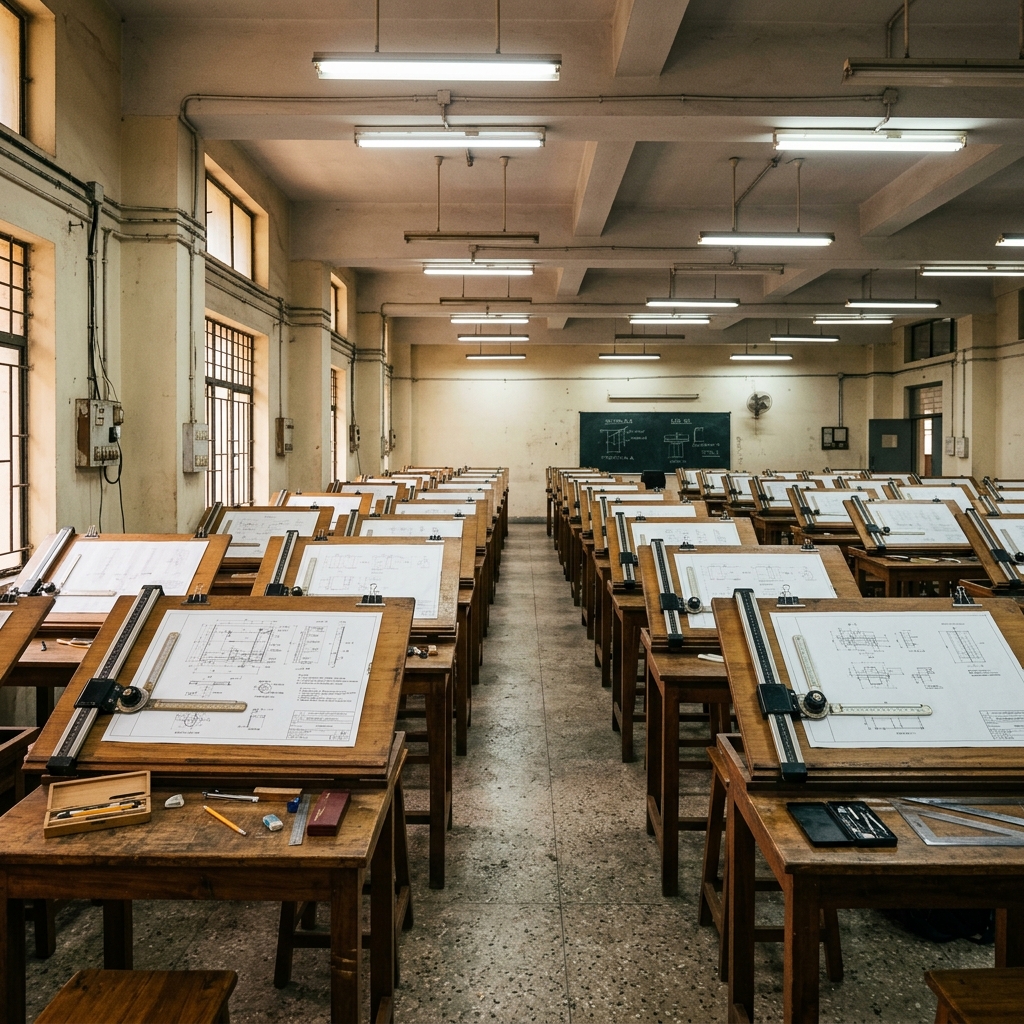
Labs make up a significant portion of your first-year grades. In school, lab marks were often given out generously. In engineering, labs are where your grades can bleed out quietly if you are not careful.
Mastering the TA Dynamic
- Never argue with a TA about a grade during the lab session itself.
- Keep your rough observation notebook neat. Many TAs value the process and raw readings more than a perfect final result.
- Submit your lab records on time. A late submission is an easy excuse for a TA to slash your internal marks.
Viva-Voce Survival
At the end of every lab session, you will face a viva (oral exam). The most common mistake is trying to bluff your way through an answer. If you do not know the answer, state it clearly. Professors appreciate honesty more than a made-up explanation that defies the laws of physics.
Study methods: engineering physics, mechanics, and mathematics
Engineering subjects require a different approach than high school science. You are no longer expected to just define terms — you are expected to apply concepts to solve practical problems. Here is a high-yield vs. low-yield breakdown.
| Subject | ✗ Avoid This | ✓ Do This Instead |
|---|---|---|
| Engineering Mathematics | Reading through solved examples in the textbook without writing them down. | Solving past five years' question papers by hand under a time limit. |
| Engineering Mechanics | Trying to memorize the steps for standard truss or friction problems. | Practicing free-body diagrams for complex, non-standard structures. |
| Basic Programming (C / Python) | Reading code from a slide deck or a textbook. | Writing and compiling the programs on your own laptop, making errors, and debugging them. |
| Engineering Drawing / Graphics | Copying sheets from a classmate during the last hour before submission. | Understanding the concepts of orthographic and isometric projection step-by-step. |
Reading through solved examples in the textbook without writing them down.
Solving past five years' question papers by hand under a time limit.
Trying to memorize the steps for standard truss or friction problems.
Practicing free-body diagrams for complex, non-standard structures.
Reading code from a slide deck or a textbook.
Writing and compiling the programs on your own laptop, making errors, and debugging them.
Copying sheets from a classmate during the last hour before submission.
Understanding the concepts of orthographic and isometric projection step-by-step.
The engineering grade matrix: how your final marks are calculated
Understanding how your final grades are compiled helps you distribute your effort effectively. Here is a visual breakdown of each grading component.
Internal Assessments / Quizzes
Never skip class tests. These are easy points that keep your baseline high.
Lab Submissions & Attendance
Purely based on discipline. Submit sheets on time and maintain 75% attendance.
Mid-Semester Exams
Focus on core derivations and textbook problems. The syllabus is small — target high marks.
End-Semester Exams
Comprehensive coverage. Focus heavily on previous years' question patterns and reference books.
Student interviews: perspective from the senior wings
We asked students from different branches and colleges to share what they learned during their first year.
Vikram
Computer Science, Chennai
"I did not have computer science in high school, so when the basic programming class started, I felt completely lost. Everyone else seemed to know how to write code. I made the mistake of hiding my confusion and copying assignments. By the time mid-sems arrived, I failed the practical exam. I had to start from scratch, using free online coding resources and asking my hostel mates for help. If you do not know basic programming, accept it early and practice coding every day for thirty minutes."
Tanya
Mechanical, Pune
"Engineering graphics was my biggest nightmare. I spent hours trying to get the lines perfect, but the TA kept rejecting my sheets. A senior told me that the problem was not my drawing, but my drafter alignment. Once I learned how to calibrate the mini-drafter correctly, my sheets got accepted on the first try. Always get your tools checked by a senior before the semester starts."
Rahul
Information Technology, Hyderabad
"I thought I could study for engineering maths the same way I studied for JEE. I was wrong. JEE is about multiple-choice shortcuts. Engineering mathematics exams require you to write down detailed, step-by-step proofs and derivations. If you skip steps, you lose marks, even if your final answer is correct. Learn to write clean, step-by-step solutions."
Original insights: what seniors wish they knew earlier
The Xerox Shop is the Center of Knowledge
Every engineering campus has a local photocopy shop, usually located just outside the main gate or in the basement of the academic block. The xerox shop owner keeps stacks of previous years' question papers, solved notes from the toppers of previous batches, and question bank solutions. When you are struggling to understand a subject, visit the xerox shop and ask for the standard reference notes for that subject.
The Attendance Calculation Illusion
Most colleges have a strict 75% attendance rule. Freshmen often calculate their attendance margin down to the last lecture, trying to maximize their bunking days. This is a risky game. If you fall sick at the end of the semester, your calculated margin will disappear, and you will be barred from writing the exams. Keep a safety margin of attendance for real emergencies.
The Branch Change Mirage
Many students join college with the plan: 'I will take civil engineering now, study hard, and change my branch to computer science next year.' While this is theoretically possible, the reality is that only the top 1% to 2% of the entire batch manages to change their branch. Do not rely on a branch change as your primary plan. Treat it as a bonus, and focus on succeeding in the branch you have.
Your practical action plan: first-semester survival roadmap
Here is a step-by-step timeline to help you transition into college during your first month. Start this on day one — do not wait.
Phase 1
First 48 Hours
- Collect your syllabus copy from the department website or the library.
- Find the nearest campus photocopy shop and locate the senior hostel wing.
- Do not buy brand-new textbooks yet — ask seniors which reference books are actually used.
Phase 2
Week 1 — Set Up Your Tools
- Get your lab equipment ready: mini-drafter, lab coat, Casio fx-991EX calculator.
- Set up a cloud folder (Google Drive or OneDrive) for PDFs and assignment sheets.
- Identify the classmates who are serious about studying — they will shape your habits.
Phase 3
Month 1 — Resource Hunt
- Identify high-quality study resources for your difficult subjects: NPTEL lectures, YouTube channels, student notes.
- Start writing your lab records on the day the experiment is conducted. Do not wait for the weekend before submission.
Phase 4
Mid-Semester Checkpoint
- Review your performance after the first class tests.
- If you scored low in a subject, change your study resource. Do not keep reading the same textbook if it is not helping you solve the problems.
Street-smart wisdom from seniors
Senior Student Advice
"If you are stuck on a difficult engineering mechanics or math problem, do not spend three hours trying to solve it alone. Go to the senior hostel wing after dinner. Walk into any room where seniors are hanging out and ask them. Most seniors are happy to help a fresher solve a problem, and they will probably show you the exact trick that the professor uses to set the exam paper."
— Shrijit, Final Year Electronics, DelhiCommon Mistake Alert
Never copy code directly from a classmate's repository or use online tools to write your programming assignments without understanding the logic. Many universities now run automated plagiarism detection software on code submissions. If your code matches another student's work line-for-line, both of you will receive a zero mark, and you will face disciplinary action.
Expert Tip
"The biggest challenge for freshers is the transition from JEE preparation, which was entirely objective, to university exams, which are highly subjective. Focus on explaining the logic behind your derivations, drawing clean schematics, and writing out the final units clearly. Even if your final numerical answer has a calculation error, a well-structured derivation can get you 80% of the total marks."
— Dr. Amit Verma, Professor of Mechanical EngineeringFrequently Asked Questions
Is first-year engineering difficult compared to high school?
Yes, the volume of study material is much higher, and the exams require conceptual application rather than rote memorization. However, if you develop a consistent study routine early, it is highly manageable.
How can I maintain a CGPA above 8.0 in my first year?
Maintain your lab grades by submitting records on time, attend lectures regularly to capture class notes, and solve the past five years' university question papers before your exams.
Do companies look at first-year engineering marks during campus placements?
Yes. Your first-year marks are part of your cumulative CGPA. Companies use your cumulative CGPA as an initial eligibility filter for both summer internships and final placement drives.
What are the most common subjects in first-year engineering?
Almost all engineering branches study the same subjects in the first year. These typically include Engineering Mathematics, Physics, Chemistry, Basic Electrical Engineering, Mechanics, Computer Programming, and Engineering Graphics.
How do I handle engineering drawing if I have poor drawing skills?
Engineering drawing is not an artistic skill. It is a technical representation based on geometry and rules. Using the correct tools, keeping your pencils sharp, and aligning your mini-drafter properly will get you clean, accurate sheets.
Can I change my engineering branch after the first year?
Yes, but the options are highly competitive. It is based entirely on your first-year CGPA, and only a tiny percentage of the top students are allowed to switch branches.
How do I balance studies and social life in an engineering hostel?
Create a routine where you finish your lab reports and assignments during the weekdays. This leaves your weekends free for social activities, projects, and relaxation without academic stress.
What laptop is best for a first-year engineering student?
For the first year, a basic laptop with an Intel i5 or Ryzen 5 processor, 16GB of RAM, and a decent SSD is more than enough. You do not need an expensive gaming laptop unless you are planning to run heavy 3D rendering software later in your course.
What happens if I fail a subject in my first semester?
If you fail a subject, you get a backlog (often called a 'back' or 're-appear'). You will have to write the exam again in the next semester or during the summer term. Having a backlog is stressful and affects your CGPA, so try to avoid them.
Wrap-up: your next immediate step
Engineering is a marathon, not a sprint. The key to surviving the first year is not to study for twelve hours a day, but to remain consistent.
Your immediate next step is to download the syllabus for your current semester. Open a note file on your phone, list the subjects you are registered for, and find one reliable study resource — a YouTube playlist or senior notes — for each subject before the next week starts. Getting this small task done now will save you weeks of stress when exams arrive.
If you are looking for study trackers, community notes, and campus guides, check out the resources section on TownMate. We are here to help you make your college years count.