How to Find a Hostel Roommate Online in India (2026 Complete Guide)

"Finding the right roommate before you arrive makes move-in day a very different experience."
Sahil had two weeks before his session started at a private engineering college in Bhopal. He needed a roommate to split a PG flat because the college hostel waitlist was long and the rent alone was going to stretch his budget. He asked around in his college WhatsApp group, got no response, posted in a Facebook group for the city, and got three responses — two of which were from people who seemed to disappear after the first message, and one who turned out to already have filled the spot.
He moved in alone. Paid the full rent for two months. Found a roommate through a junior's reference in October, by which point he'd already lost significant money and spent two months in a flat that felt isolating.
Finding a hostel roommate online in India in 2026 is genuinely possible, and students do it successfully every year. But there's a difference between randomly posting in groups and actually running a structured search.
Before You Read: Quick Summary
What this covers
Platforms, safety checks, compatibility questions, red and green flags, the search timeline, and the exact process for finding a roommate online in India.
Who this is for
Students moving into hostels or PG flats in a new city, students looking to split rent, students who've had bad luck with group posts.
Key takeaway
Most students search too late and too broadly. A narrow, specific, early search on the right platform produces significantly better results than mass posting.
Why the "Post in WhatsApp Groups" Method Keeps Failing
This is where most students start and where most searches stall out. The college WhatsApp group, the city's Facebook group, the Instagram "looking for roommate" story — these are all volume plays. You're casting wide and hoping someone compatible sees your post at the right moment.
The conversion rate is terrible, the quality of responses varies wildly, and there's almost no structure to help you figure out whether the person responding is actually a good fit.
The Timing Problem: WhatsApp group posts are ephemeral. They disappear in 24 hours of conversation. By the time someone who might be a great match joins the group, your post is gone.
It isn't that these platforms are useless — it's that they work best as supplements, not as your primary search strategy.
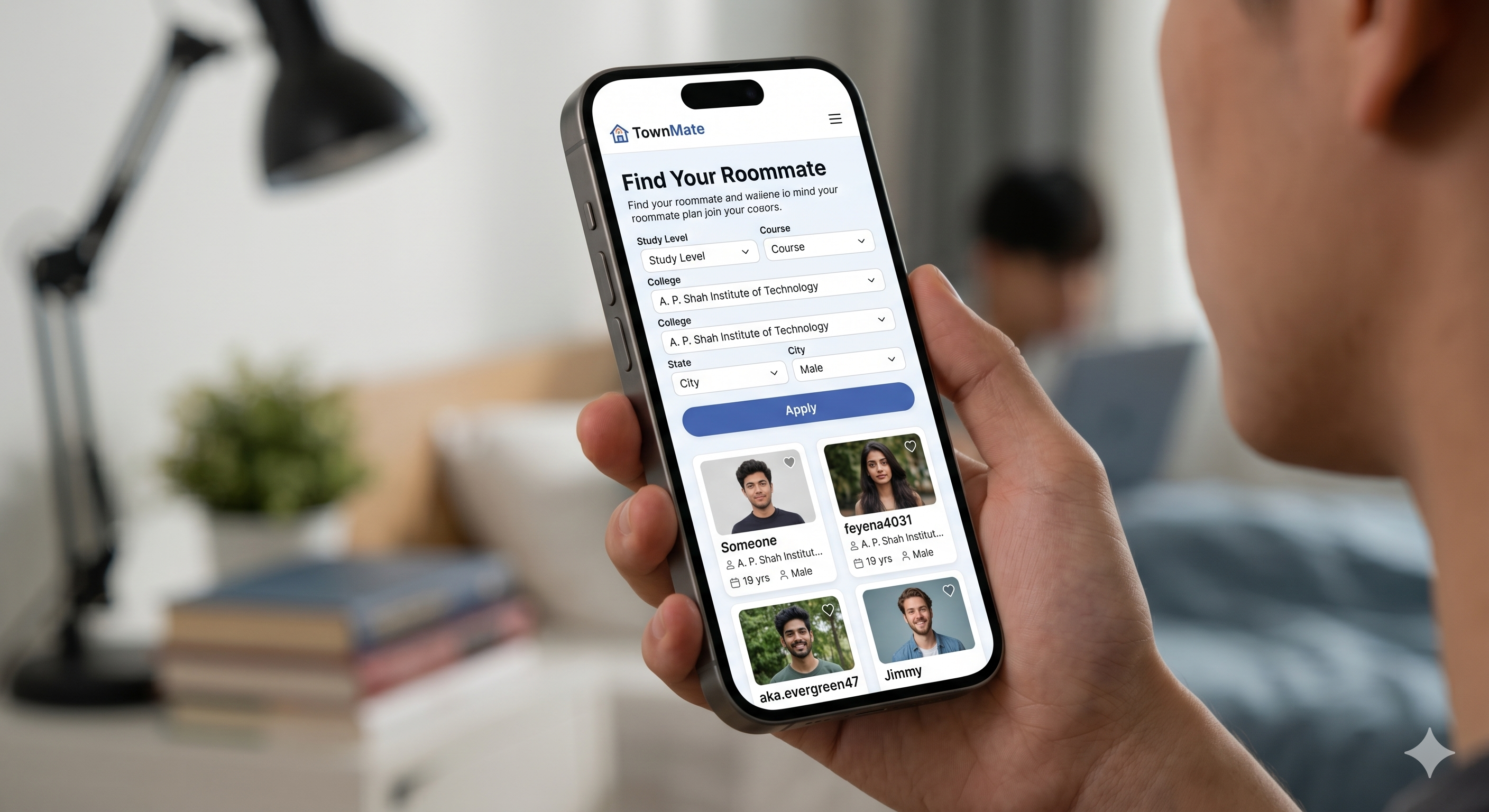
"The right platform matters more than the number of places you post."
Where Students Are Actually Finding Roommates in 2026
Here's an honest breakdown of where the volume is and what each channel is actually good for.
| Platform / Channel | Best For | Reach | Safety | Quality | Time |
|---|---|---|---|---|---|
| TownMate | Students/Verified | Growing | High | High | Low |
| NoBroker / NestAway | Shared Flats | Very High | Medium | Medium | Medium |
| Facebook Groups | Broad Reach | High | None | Low-Med | High |
| Quora / Reddit | Advice | Moderate | None | Varies | Medium |
| College WhatsApp | Same-College | High | None | Medium | Low-Med |
| OLX Roommates | Flat-sharing | Moderate | Basic | Low | Low |
| Visual/Social | Medium | None | Low | Medium |
The Two-Channel Strategy
The most effective approach most students report using is a two-channel strategy: one platform purpose-built for student roommate matching (like TownMate) where profiles are structured, plus their own college's communication channels to find someone from the same institution.
Why It Works
The reason the two-channel approach works is simple. The purpose-built platform gives you reach and structure; the college channel gives you the social proof of a shared institution, which accelerates trust.
The Profile That Actually Gets Responses
Most students post generic requests that get ignored. To stand out, you need to provide enough context for potential roommates to assess compatibility instantly.
Who You Are
Be specific. Instead of just 'engineering student', mention your year, branch, college, and hometown.
Your Schedule
Define your rhythm: Are you an early riser? Do you have late-evening classes? Help them visualize your daily routine.
Habits & Preferences
State your deal-breakers: Study noise, cleanliness, or food preferences. Directness saves everyone time.
Your Ideal Roommate
Define the fit. Look for shared expectations on costs and habits rather than just 'someone nice'.
Location & Budget
Clear parameters: Which area of the city? What's your max budget? Are you searching together or joining a flat?
The Human Element
Add one genuine hobby or interest. It transforms your profile from a data point into a real person.
Pro Tip: A profile that feels like a real human wrote it is exponentially more likely to receive quality responses. Don't fear being too detailed — detail acts as a filter that attracts your best match.
The Questions That Reveal Compatibility Before You Move In
Once you've found someone who seems like a possible match, most students skip straight to logistics — address, rent, move-in date. That's backwards. The logistics conversation is useless if the person turns out to be fundamentally incompatible. Have the compatibility conversation first.
Note: You don't ask all of these in the first message. You work through them naturally across two or three conversations. But you shouldn't agree to share a room without covering most of this ground.
Myth vs. Reality: What Students Get Wrong About Online Roommate Search
Many students approach online searches with outdated assumptions. Dispelling these myths is the first step toward finding a living arrangement that actually lasts.
| Common Myth | The Reality |
|---|---|
| You should find someone from the same state or community — more compatibility | Shared background is not the same as shared habits. Sleep schedules and cleanliness standards are far better predictors of a workable living arrangement than origin |
| Finding someone online is riskier than through references | A structured online search with verification steps is often safer than a rushed reference who turns out to be an acquaintance of an acquaintance |
| The faster you move, the better — good rooms go fast | Speed is important, but rushing into an incompatible arrangement costs you the entire year. Two or three days of careful matching is worth it |
| If they're from your college, they're automatically trustworthy | Same college is useful social proof, not a character guarantee. Always verify and always talk before committing |
| Online roommate search is only for big cities | Platform reach in Tier 2 cities like Indore, Nagpur, Coimbatore, and Bhopal has grown significantly. The volume might be lower but the matches are often more targeted |
| You can always change roommates later if it doesn't work | Mid-semester changes involve admin processes, sometimes additional costs, and significant disruption. Getting it right upfront is far less painful than fixing it in month three |
The Takeaway:Don't let the pressure of the search force you into compromises. Prioritize behavioral alignment over convenience, and always verify before you commit.
The Safety Checklist: Before You Meet or Move In
This section is not optional reading. Online searches require verification steps that reference-based searches skip by default, and skipping them creates real risk.
Video Call
Before sharing your address, do a 15–20 minute video call. Text can be curated; a video call cannot.
Institutional ID
Ask for a college ID or enrollment number. If they resist sharing this basic info, that is a red flag.
Social Consistency
Cross-check platforms like LinkedIn or Instagram to confirm they actually attend the campus they claim.
Mutual Connection
Find at least one person who can vouch that they are who they say they are.
Public Meet-up
Meet in a café or campus area before moving in. This is a standard, reasonable expectation.
Address Privacy
Only share your full address after the public meeting and once you feel entirely comfortable.
Trust Readiness
Completing all 6 steps ensures a 100% verified safety foundation. Don't skip steps to save time.

"A first meeting in a public place before moving in together is simple and worth doing every time."
Red Flag vs. Green Flag Checklist
Trust your intuition, but verify with evidence. Look for these behavioral markers during your initial interactions to gauge the reliability of a potential roommate.
Red Flag Checklist
- ✕Refuses a video call or keeps rescheduling it without explanation
- ✕Cannot or will not provide any institutional verification
- ✕Rushes you toward moving in before you've had a compatibility conversation
- ✕Gives inconsistent information across different messages
- ✕Asks for a deposit or advance before you've met in person
- ✕Has no social media presence whatsoever, or accounts that look recently created
- ✕Gets defensive or aggressive when you ask standard questions
- ✕Cannot name a single person in the city or college who knows them
Green Flag Checklist
- ✓Suggests a video call themselves before you ask
- ✓Shares their college enrollment information without hesitation
- ✓Has asked you questions about habits and schedule — means they're thinking about compatibility too
- ✓Can name specific people, places, or events related to their college
- ✓Agrees to a public meeting before committing to the arrangement
- ✓Responds to messages consistently and within reasonable time
- ✓Their account history and posts are consistent with who they say they are
Student Voices: How They Actually Found Their Roommates
Real experiences from students who have navigated the search process. Here is what worked for them when finding a roommate who actually fits.
Deepa
1st Year, B.Sc Nursing, Manipal
"I posted in the college's incoming batch group in March — four months before admission. Got two responses. Talked to both of them over multiple calls. One of them and I had completely different sleep patterns, which I only found out because I specifically asked. The second one and I matched on almost everything. We're still roommates in the third year. Starting early was the single biggest factor."
Vikram
2nd Year, MBA, Ahmedabad
"I found my current roommate on TownMate. What surprised me was how much the profile structure helped — because both of us had filled in our habits and preferences, we already knew a lot about each other before the first call. We had one video call, met once on campus before the semester started, and moved in the same week. The whole process took about twelve days from first contact to move-in."
Ananya
1st Year, B.Com, Delhi
"I tried the Facebook group route first. Three responses in two weeks, none of them followed up properly. Then a senior told me to post specifically in our college's alumni-junior network because alumni who'd lived off-campus knew which areas were good and sometimes had contacts for roommates. That's how I found my current roommate — through a third-year who knew someone in my batch who was also searching. The lesson I took from it: your college network is more powerful than random city groups, but you have to use it more creatively."
Ravi
1st Year, MBBS, Kota
"Coaching centres in Kota have a different dynamic. Almost everyone is looking for a roommate and almost everyone is from out of state. I found my roommate through a coaching institute noticeboard — physical, not digital. He was from a different state, completely different background, but we had nearly identical schedules because coaching made our days very structured. We barely had to negotiate because the routine was already set by the institute."
Neha
3rd Year, B.Tech, Hyderabad
"My advice to first-year students searching online: don't look for a friend. Look for someone you can function with. Those are different things. My current roommate and I are not close friends. We have different social circles. But we have the same standards for cleanliness and the same evening schedule, and we've never had a single conflict in two years. That's better than a close friendship that has daily friction over noise and mess."
The Search Timeline: When to Start and What to Do Each Week
Most students start searching too late. They wait until two weeks before the session, panic, and take the first available option. Here is a timeline that produces much better outcomes:
Create your profile on TownMate and one other platform. Post in your incoming college batch group if it exists.
Begin conversations with leads. Do video calls. Run through compatibility questions.
Narrow to 2–3 serious candidates. Do reference checks. Plan a public meeting if you're already in the city.
Finalize your choice. Discuss logistics — rent split, deposit, move-in date, shared expense rules.
Confirm the arrangement in writing (even just a WhatsApp message summarizing what was agreed).
Establish shared expectations clearly on Day 1 — lights, guests, cleanliness, study time.
"Starting three to four months out feels unnecessary until you realize that the students who do this consistently report better matches. The pool of options is larger, neither person is desperate, and both sides have time to be selective."
Original Insights: What Most Articles on This Topic Miss
The Desperation Effect
Quality is inversely proportional to urgency. Start early to avoid choosing from whatever is left.
Context vs. Schedule
Same college doesn't mean same schedule. Institutional trust is not a substitute for compatibility.
The Post-Move-in Trap
Skipping compatibility talks to avoid 'awkwardness' leads to passive friction that is harder to fix later.
The TownMate Advantage
Forcing structured profile input builds necessary self-awareness about what you actually need.
The Gender Safety Gap
Students who implement basic safety checks like video calls and social cross-checks see materially fewer problems.
Practical Action Plan
Stop reading and start executing. Follow this four-week roadmap to move from "searching" to "settled."
Profile Update
Create or update your profile on TownMate with the six-part profile framework. Be specific — not generic. A complete profile gets responses.
Outreach
Post in your college's incoming batch group or alumni network with a specific request: schedule type, budget, and area. Ask leads to fill in your platform profile.
Screening
Respond to serious messages. Schedule video calls and keep a simple notes document — track names, dates, and compatibility scores.
Verification
Run your shortlist through the safety verification checklist. Request institutional IDs and reference contacts.
Deep Dive
Meet your top choice in public. If remote, conduct a long video call focusing specifically on logistics and house expectations.
Commitment
Finalize your choice. Draft a simple shared agreement covering rent, deposit, and rules via WhatsApp and confirm the move-in.
The Shared Expense Framework & Essential Reality Checks
Most roommate conflicts are predictable—and entirely avoidable. Before you commit, you must formalize your financial boundaries and sanity-check your potential match with these non-negotiables.
Financial Agreement Checklist
| Item | Decision Needed |
|---|---|
| Rent split | Equal, or adjusted for room size/position? |
| Deposit | Who pays what now, who gets what back later? |
| Utilities | Split equally, or tracked individually? |
| Shared supplies | Small shared fund or alternate purchasing? |
| Late rent policy | What happens if one person can't pay on time? |
| Notice period | How much advance notice if someone needs to move out? |
*Note: A simple WhatsApp summary of these points is sufficient to protect both parties from future misunderstandings.
"The best indicator of how a potential roommate will handle conflict is how they talk about their last difficult living situation. If they speak with complete absence of self-awareness—entirely blaming the other person—take note."
Finding the right roommate online is one part of the process. What you do in the first week of living together determines whether the good match stays good.
Have a brief, practical conversation on Day 1 or 2 — not a formal meeting, just a chat about the basics. What time are lights off on weekdays? How do guests work? Who handles which shared supplies this month? Is there a preferred side of the room?
Ten minutes of this conversation in week one eliminates the majority of friction that would otherwise develop over the following two months. Most students skip it because it feels unnecessary when everything is new and both sides are on their best behaviour. That's precisely why it works — things are easiest to agree on before a conflict creates defensiveness.
At TownMate, we've tracked how students who report their living situations six months after move-in found their roommates. The ones who report functional, low-conflict arrangements consistently have two things in common: they spent time on compatibility before committing, and they set expectations clearly in the first week.
Neither of those things is complicated. Both require a small, deliberate effort that most students don't make. You now know what that effort looks like.
Start your profile today. Treat the search like a process, not a prayer. And don't move in with anyone you haven't spoken to on video, verified in at least two ways, and met in person once.
That's genuinely all the distance between a good first year and a difficult one.
Frequently Asked Questions
Which is the best app to find a hostel roommate in India in 2026?
TownMate is specifically built for student hostel and PG roommate matching in India, with structured profiles that make compatibility assessment easier before the first conversation. NoBroker and NestAway are useful for finding existing flat shares. For students, a purpose-built platform almost always produces better-fit matches than general real estate apps.
Is it safe to find a roommate online in India?
Yes, with the right process. The risks associated with online roommate search are real but manageable with standard verification steps — video call first, institutional verification, social media cross-check, and a public meeting before committing. Students who follow these steps consistently report positive experiences.
How far in advance should I start looking for a hostel roommate?
Ideally, two to three months before your session starts. Students who start this early have more options, less desperation-driven decisions, and more time for proper compatibility assessment. Starting two weeks before is possible but significantly limits your choices.
What questions should I ask a potential roommate before agreeing to share?
The most important ones: What time do you sleep and wake up? Do you study in the room or outside? How often do you have guests over? How do you handle it when something bothers you about a roommate? These four questions reveal the majority of potential incompatibilities.
How do I verify that someone I met online is who they say they are?
Ask for their college enrollment number, check their social media for consistency with their story, do a video call, and ask for one reference — even a casual acquaintance from their institution. None of these steps are invasive, and anyone legitimate will not hesitate.
What if I can't find a roommate before the session starts?
Move into temporary single accommodation if possible rather than taking the first available option out of pressure. One month of paying slightly more is worth it compared to six months with an incompatible roommate. Continue your search actively and update your profile — many students start searching mid-semester when their initial arrangements fall apart.
How do I bring up compatibility topics without it feeling awkward?
Frame it as mutual benefit. 'I want to make sure we're both set up for a good year, so can I ask a few practical questions about schedules?' Most people respond positively to this framing because they want the same thing. The awkwardness is mostly in the anticipation, not the conversation itself.
Can I find a roommate from a different college to share a PG flat?
Absolutely. In many cities — particularly those with multiple colleges like Pune, Hyderabad, Bengaluru, and Delhi — most PG flat-sharing happens across institutions. Shared schedule and habits matter far more than shared institution for day-to-day compatibility.
What's the difference between a hostel roommate and a PG roommate search?
A hostel roommate is assigned or requested through your college's accommodation office — the online search is mainly for influencing who you're paired with, or for co-requesting a room with a known person. A PG roommate search is fully self-directed, involves lease agreements and shared finances, and requires more thorough vetting since there's no institutional structure around it.
What should the first message to a potential roommate say?
Be specific, not generic. Instead of 'Hi, I saw your post, I'm also looking for a roommate,' try: 'Hi, I saw your profile. I'm a first-year B.Tech student at [college] starting in July. I'm an early riser and study mostly in the evenings — looks like you mentioned similar habits. Would you be open to a quick call this week?' Specific messages get responses. Generic ones don't.
Should I share my phone number with someone before meeting them?
Not necessarily before a video call. Use the platform's messaging system or WhatsApp (without sharing your full address or personal details) until after you've done a video call and cross-checked their basic information. Share your number when you're ready to progress to a public meeting.
What happens if my online-matched roommate turns out to be a bad fit after moving in?
Handle it the same way as any roommate problem — direct conversation first, then escalate to hostel management or landlord if needed. The advantage of having done compatibility due diligence is that you have a clear record of what was agreed. This makes the conversation about a specific deviation from agreement rather than a vague complaint.
Further reading
Deepen your knowledge with these curated TownMate guides, designed to help you navigate your student life with confidence.