
How One Bad Roommate Can Ruin Your Entire First Year of College (And What to Do About It)
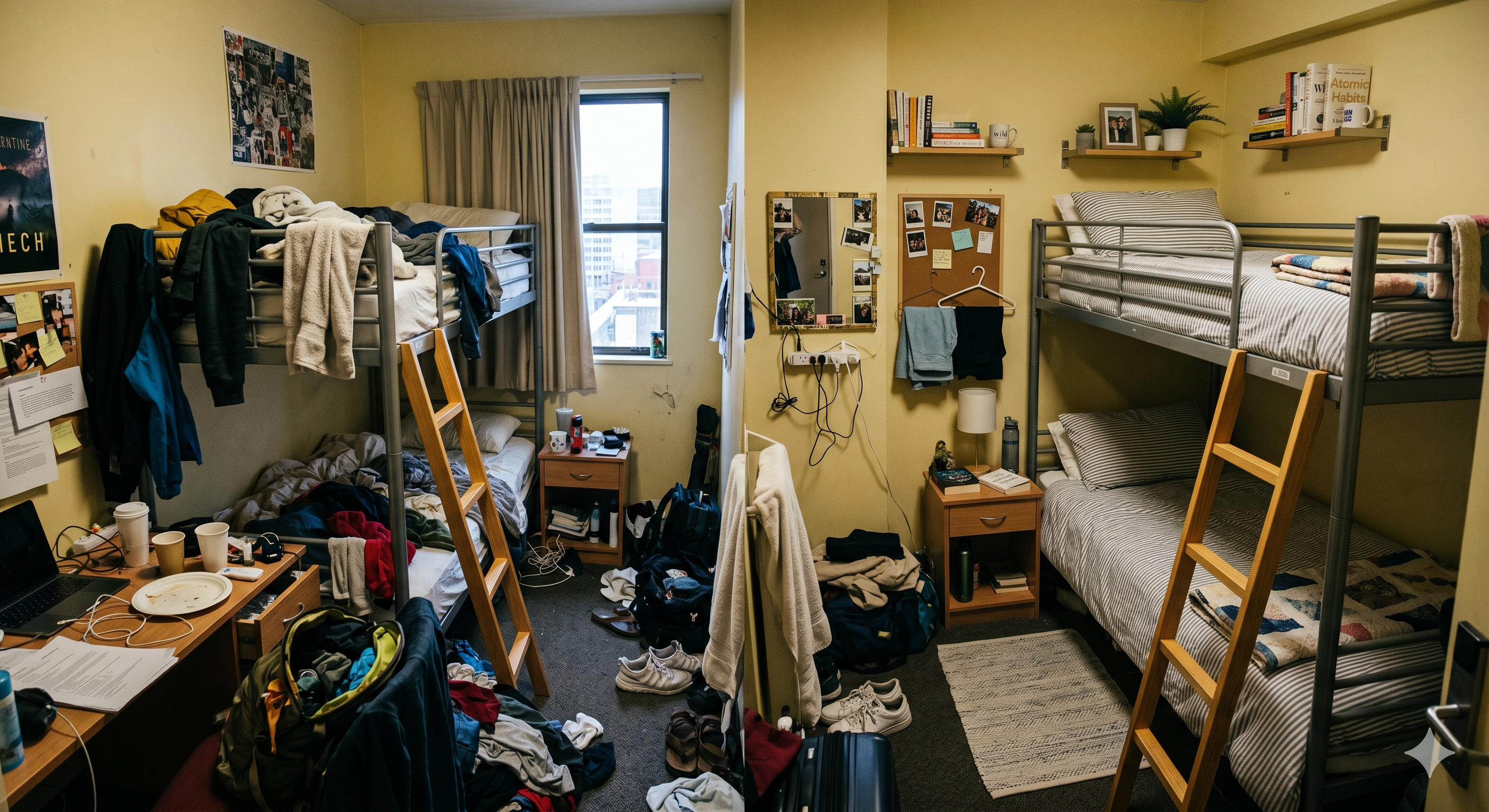
"The gap between a good and bad roommate is wider than you think."
Nobody warned Meera about this part.
She had gotten into a decent engineering college in Nagpur, cleared her entrance exam on the second attempt, and was genuinely excited about moving out of her hometown for the first time...
. She'd packed carefully, spoke to her parents about rules, and moved into the hostel in the first week of July.
Her roommate seemed fine at first. Friendly, even.
By October, Meera was failing two subjects, hadn't slept before 2 AM in three weeks, and had started skipping meals because the tension in the room made her stomach hurt. She hadn't seen this coming.
The thing nobody tells you before your first year of college is this — your roommate will affect you far more than your professors will. More than your syllabus. Sometimes more than your own discipline. You can be the most motivated student in the building, and one incompatible person sharing your four walls can quietly dismantle everything you came there to build.
This article is about that. Not the generic "how to be a good roommate" advice you've already read. This is about understanding the real damage a bad roommate does, recognizing the warning signs early, and knowing exactly what to do before things spiral beyond recovery.
Quick Summary
| What This Article Covers | Who Should Read It |
|---|---|
| How bad roommates damage academics, health, and mental wellbeing | Students moving into hostels or PGs for the first time |
| Early warning signs of a toxic or incompatible roommate | Students already in a difficult roommate situation |
| Practical frameworks for handling conflicts and protecting yourself | Parents researching hostel dynamics for their children |
| Real student experiences and interview insights | Anyone searching for roommate advice before college begins |
Key takeaway: A bad roommate rarely looks like a problem on day one. The damage is gradual, and by the time most students realize what's happening, the semester is already gone.
Reading Time: Approximately 12–15 minutes
The First Year Isn't Just About Studying
Before we talk about bad roommates specifically, it helps to understand what the first year of college actually is.
For most students, this is the first extended period away from family. You're managing your own schedule, your own food, and your own sleep. You're making friends from scratch in a new city, adjusting to a college workload that is nothing like school, and figuring out who you are without the structure of home.
"That's already a lot. Now add a roommate who plays music until 1 AM, has five friends over every night, borrows your things without asking, or creates such an emotionally charged atmosphere that you cannot study in your own room."
The first year is fragile in ways most students don't admit until it's over. A bad roommate attacks that fragility precisely where it hurts most — your sleep, your study space, and your peace of mind.
How a Bad Roommate Actually Ruins Your Year (It's Not What You Think)
Most students imagine "bad roommate problems" as dramatic fights or theft. The reality is much quieter and much more damaging.
Sleep Deprivation Compounds Every Other Problem
Sleep is the one thing you cannot borrow or recover overnight (pun intended). A roommate who stays up late, watches videos on speaker, has phone calls at midnight, or even just snores loudly enough to keep you awake will cost you something you cannot get back.
Studies on sleep and academic performance consistently show that even 90 minutes of lost sleep per night significantly affects memory consolidation, problem-solving ability, and concentration. That's not a minor inconvenience — that's your exam performance, your lab attention, your ability to understand a lecture.
At TownMate, we hear from students who describe losing two to three hours of sleep every night for months because of a single roommate's habits. By November, they've accumulated a sleep debt so severe that caffeine barely functions.
Your Room Becomes a Place You Want to Escape
This one is subtle but devastating. When home — even a hostel room — stops feeling like a safe space, students start avoiding it. They sit in corridors. They go to cafes. They study in common areas or libraries. Some spend more time outside than makes sense just to avoid going back.
This displacement costs focus. You can't replicate the quality of being settled in your own study space when you're sitting on a plastic chair in a hallway.
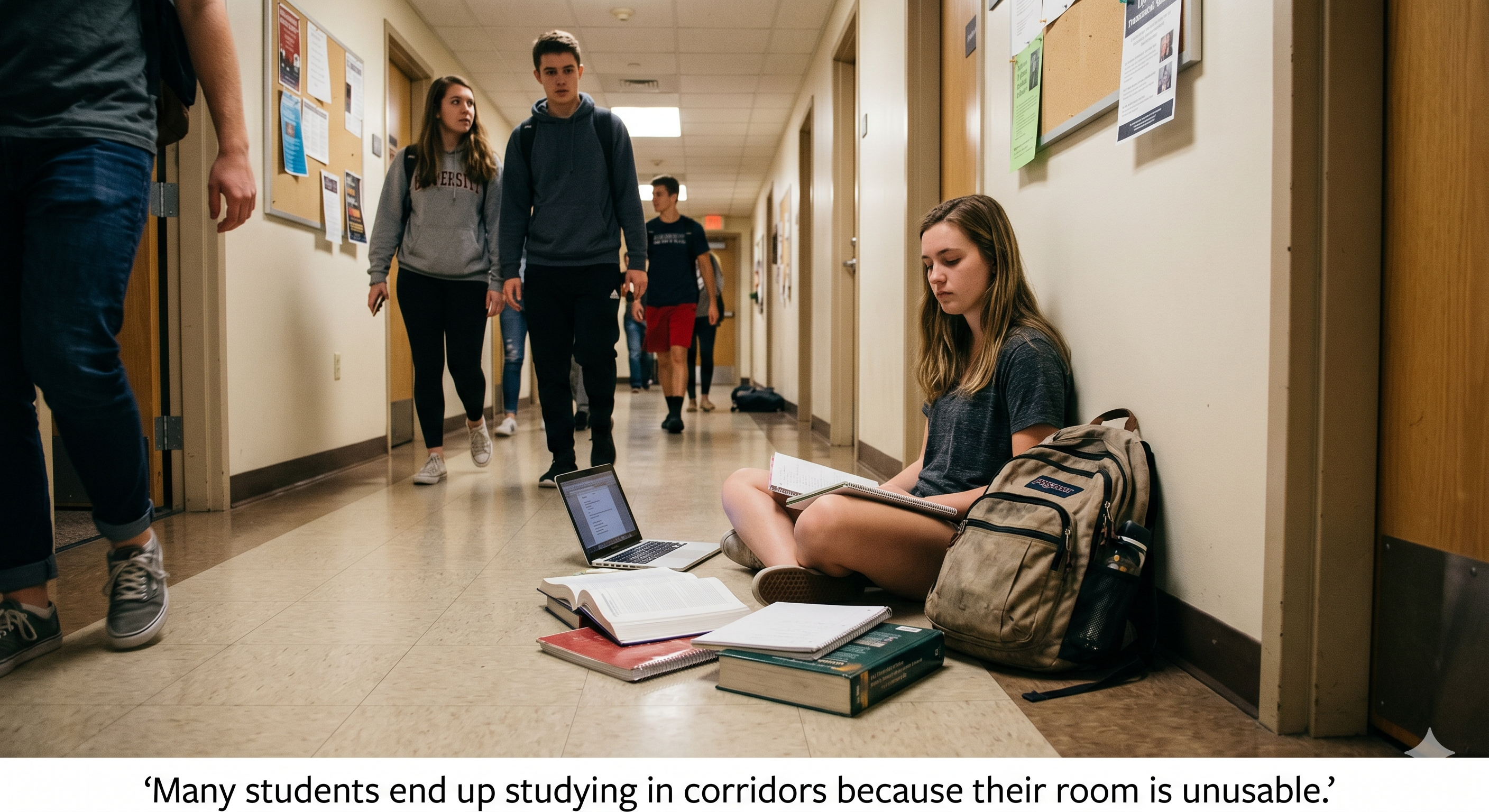
"Many students end up studying in corridors because their room is unusable."
Social Dynamics Get Complicated
A difficult roommate can also affect who you become friends with in the first year. If your roommate brings certain friend groups into the room constantly, or creates social drama that leaks into your floor or hostel wing, you get pulled into dynamics you never wanted to be part of.
Some students end up isolating because they don't want to deal with the social complexity around their roommate. Others compromise their own friendships to keep the peace.
The Constant Low-Grade Stress
This is the most underestimated damage. Even if you're not fighting, living with a bad roommate creates a constant background stress. You're always aware of what they're doing. Always slightly braced for the next inconvenience. Always managing your behaviour to avoid conflict.
That cognitive load doesn't disappear when you open your textbook. It sits there, quietly draining energy you should be spending on learning.
Warning Signs You Have a Bad Roommate (Before It Gets Serious)
| Warning Sign | What It Means | How Serious |
|---|---|---|
| Consistently sleeps past noon, stays up past 2 AM | Sleep schedule incompatibility | High — affects your sleep directly |
| Brings guests without asking, frequently and late | No regard for shared space as yours too | High — room becomes unusable |
| Borrows things without asking, or asks repeatedly | Boundary issues, poor respect for others' property | Medium to High |
| Never cleans their side, leaves common areas dirty | Hygiene incompatibility | Medium — depends on your tolerance |
| Plays music, videos, or calls on speaker regularly | Noise incompatibility | High — direct study and sleep disruption |
| Makes passive-aggressive comments instead of talking | Emotional intelligence issues, difficult to resolve | High — creates ongoing tension |
| Shares your personal information with others | Trust issue, serious boundary violation | Very High |
| Brings substances into the room | Legal and ethical boundary, peer pressure risk | Very High |
The key distinction to understand: there are incompatible roommates and there are toxic roommates. Incompatibility — like different sleep schedules or cleanliness standards — can sometimes be worked out. Toxicity — involving manipulation, disrespect, or harmful behaviour — rarely gets better through conversation.
What Most Students Get Wrong About Roommate Problems
Waiting Too Long
Things will eventually improve on their own.
Habits developed over years don't shift overnight. If you notice a serious incompatibility in week two, that is the time to address it — not week eight. By November, the pattern is locked in.
Confusing Politeness
Keeping the peace means avoiding difficult talks.
Being polite doesn't mean you can't state a need. Asking for lights off by 11 PM isn't rude; it's a reasonable boundary. Avoiding that conversation is avoidance, and it costs more than a five-minute talk.
Avoiding the Warden
Asking for help seems like 'tattling'.
Hostel wardens and student welfare officers exist precisely for this reason. A room change request is a legitimate, normal solution. Don't let embarrassment keep you stuck in a situation that is costing you academically.
Student Voices: Real Experiences With Bad Roommates
Real stories from students across India highlight how sleep issues, social drama, and passive-aggressive behavior can quietly dismantle a semester.
"My roommate... was just on a completely different schedule. I started failing to understand concepts in morning lectures because I was so tired. I thought I was just 'not cut out' for engineering. I requested a room change in the second semester and my grades jumped almost immediately."
— Arjun, Pune
"She'd study at 4 AM with a lamp on, sleep during the day, and have loud phone conversations when I was trying to revise. The worst part wasn't even the noise — it was the guilt I felt for being bothered by her."
— Priya, Kota
"My roommate used to bring four or five people into our room every evening. Eventually I just started going to the library and staying till closing. But then I stopped having any social life at all."
— Rohan, Delhi
"My roommate wasn't loud or messy... But she had this habit of making comments — about my clothes, my study methods, my phone calls. It took me months to realize that what was happening was a form of emotional undermining."
— Fatima, Hyderabad
"I was lucky. My roommate and I sat down on literally the first day and talked about schedules, expectations, guests, and cleanliness. It felt awkward for about ten minutes. But we never had a serious problem the whole year."
— Kabir, Chennai
The Compatibility Framework: What Actually Determines Roommate Compatibility
Most students think compatibility is about personality. Whether you "get along." Whether you like the same things. That's almost irrelevant. What actually determines compatibility is far more specific:
| Compatibility Factor | Why It Matters | Questions to Ask Before Moving In |
|---|---|---|
| Sleep schedule | Night owl + early riser = guaranteed friction | What time do you usually sleep and wake up? |
| Study habits | Silence vs. background noise preferences clash constantly | Do you study in the room or outside? Do you need silence? |
| Guest frequency | Your room is your home. Shared homes need shared rules. | How often do you have people over? For how long? |
| Cleanliness standard | Objective differences in hygiene can create real health issues | How would you describe your room habits at home? |
| Phone/music habits | Speaker volume in a 100 sq ft room is a serious issue | Do you wear headphones or use speaker mostly? |
| Financial habits | Shared expenses create friction if expectations differ | Are you comfortable splitting shared costs upfront? |
| Emotional style | How someone handles conflict affects the entire living dynamic | When something bothers you, do you prefer to talk about it or cool off first? |
Most of these questions feel awkward to ask before moving in. But they are exactly the questions that prevent the problems that take down entire semesters.
What to Do If You're Already Stuck With a Bad Roommate
You might be reading this from inside a bad situation. Here's a practical framework, not a generic list.
Diagnose the Problem Honestly
Separate your feelings from facts. Write down what specifically is affecting you — not 'they're annoying' but 'they play music on speaker after 11 PM at least four times a week, which keeps me awake.' Specific problems have specific solutions. Vague frustrations don't.
Have One Direct Conversation
This is non-negotiable and should happen before anything else. Pick a neutral time — not in the middle of an incident. Be specific, non-accusatory, and clear about what you need: 'Hey, I've been really struggling to sleep before 1 AM lately, and I know it's because of the noise in the room at night. Can we figure out a time cutoff for loud things?' Most roommate situations can be significantly improved by this one conversation.
Set Written Agreements
After the conversation, write down what you've agreed to. Not as a legal document — just a note on your phone or a whiteboard. 'Lights off by 11:30 PM on weekdays. Guests leave by 10 PM.' This removes the 'but I didn't know that bothered you' defense and creates a shared reference point.
Escalate Without Guilt
If the problem continues, speak to your hostel warden or student services. Requesting a room change is not a dramatic act — it's a practical solution. Frame it as a lifestyle incompatibility (which is the truth) rather than a complaint about the person.
Protect Your Minimums While You Wait
If a room change takes time, protect what matters most. Use earplugs or noise-cancelling earphones for sleep. Find a consistent alternative study space. Maintain your social connections outside the room. Don't let the room situation become your whole world.
What Seniors Wish They'd Known in First Year
Expert Tip: Room as Recovery
Your room is your recovery space. College performance is not just about how many hours you study — it's about how well you recover between study sessions. If your room is a source of stress rather than rest, you're running a deficit every single day.
Senior Student Advice
"Talk to your roommate in the first week, not the first month. The conversation feels unnecessary when everything seems fine. That's exactly when it's most effective. After problems start, the same conversation feels like a confrontation."
— Nandini, 3rd Year, NIT Trichy
Common Mistake Alert
Many students request room changes only after their semester grades are already poor. By then, they've also lost confidence and social ground. Move earlier. Your mental health and academic performance are not recoverable to the same degree after a lost semester.
Original Insights: What No One Else Is Writing About This
The 'Good Person, Wrong Roommate' Confusion!
Most students assume that if their roommate is a decent person, the problems must be their own fault. This is a genuinely damaging misconception. Two people can both be reasonable, kind individuals and still be terrible roommates for each other. Incompatibility is not a character judgment.
The Gender Pressure Factor
In many Indian college hostels, there's a social pressure — particularly among women — to be accommodating, to not complain, to adjust. This pressure keeps students in uncomfortable situations far longer than is healthy. Asking for a room change is not rudeness. It's self-care.
The Myth of 'Getting Used to It'
Students are often told they'll 'get used to' their roommate's habits. Sleep disruption doesn't get easier with time. Poor study conditions don't become fine eventually. Some things you adapt to; others just grind you down.
The Underreported Academic Impact
Students rarely connect their academic performance to roommate problems in formal records. But when counselors and academic advisors look at first-year dips in performance, roommate and housing issues are consistently among the top non-academic factors. At TownMate, conversations with over a hundred students have pointed to this pattern again and again.
Frequently Asked Questions
Can a bad roommate actually affect your grades?
Yes, and more directly than most students realize. Sleep disruption, inability to study in your room, and chronic low-grade stress all have measurable effects on academic performance. First-year students are particularly vulnerable because they haven't yet built the academic resilience that comes with experience.
What do I do if my roommate refuses to change their habits after I've talked to them?
Escalate to your hostel warden or student services office. A room change is a standard, legitimate request. You are not obligated to continue living in conditions that harm your academic performance or mental health.
How do I bring up problems with my roommate without it becoming a fight?
Choose a calm, neutral moment — not during or immediately after an incident. Be specific about the behavior, not the person. Focus on what you need rather than what they're doing wrong. 'I need the room quiet after 11 PM' lands better than 'you're always so loud at night.'
Is it normal to regret my roommate choice in the first few weeks?
Very common, and not necessarily a sign that the situation will be terrible. The first few weeks involve a lot of adjustment. Give it a direct, honest conversation before concluding the situation is unworkable.
Can I request a room change in the middle of a semester?
At most colleges, yes, though the process and availability vary. Contact your hostel management or student services as soon as possible if you want to change. Mid-semester changes are harder to arrange than beginning-of-semester ones, so don't delay unnecessarily.
My roommate isn't doing anything 'wrong' but I'm still miserable. What do I do?
This is the incompatibility scenario, not the toxicity scenario. Two people can be perfectly reasonable individually and genuinely incompatible as roommates. You don't need a dramatic reason to request a room change. Chronic sleep disruption or inability to study in your room are valid reasons.
How do I know if my roommate is toxic versus just incompatible?
Incompatibility is about habits and lifestyle differences that don't involve intent. Toxicity involves deliberate disrespect, emotional manipulation, boundary violations, or behaviour that is harmful regardless of the relationship. Toxic situations typically don't improve with a single conversation.
What if I'm the problem roommate without knowing it?
Genuinely worth asking yourself. If your roommate seems to avoid the room, is consistently passive or withdrawn, or has mentioned small issues more than once, take that seriously. Ask directly: 'Is there anything about my habits that's bothering you?' It takes more confidence to ask this than most students realize.
Does the hostel type matter — government college vs. private college?
The specifics differ but the core issues don't. Government college hostels often have less administrative flexibility for room changes. Private hostels may have more options. Either way, the interpersonal dynamics of a bad roommate are the same regardless of the institution's tier.
How do I survive the rest of the semester if I can't get a room change?
Focus on protecting your minimums. Get earplugs for sleep. Establish a consistent external study location. Maintain your social life outside the room. Minimize the time you spend in the room when your roommate's disruptive habits are active. These are damage-limitation strategies — not permanent solutions, but they prevent a difficult situation from becoming a catastrophic one.
Is it worth trying to become friends with a difficult roommate?
Friendship isn't necessary — functional coexistence is. You don't need to like your roommate. You need a workable arrangement. Trying to force friendship sometimes makes the dynamic more complicated because it blurs what is fundamentally a practical living relationship.
Should I talk to my parents about roommate problems?
If the situation is affecting your academics or mental health significantly, yes. Parents who understand the problem can also communicate with hostel management or college administration more effectively than a first-year student who feels uncertain about escalating. There's no shame in involving family when the stakes are real.
Further reading
Deepen your knowledge with these curated TownMate guides, designed to help you navigate your student life with confidence.