
Why Students Prefer Same-College Roommates (And When It Backfires)
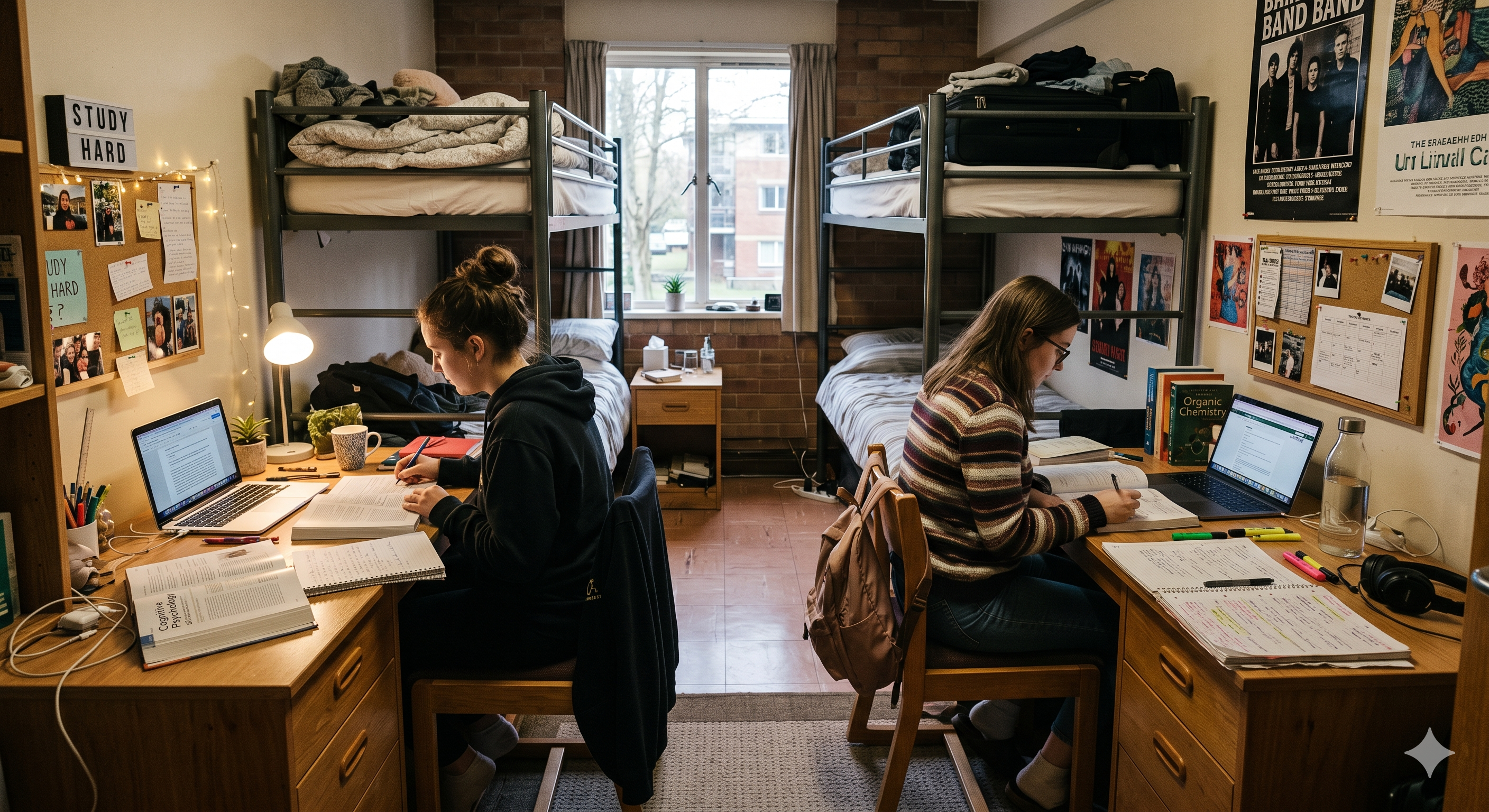
The "same-college" advantage often starts here: aligned study sessions.
The first time Ritika looked for a hostel room, she had two options: a stranger preparing for CA exams, or Neha, who sat three benches away in her BCom class. She went with Neha, almost without thinking.
Most students instinctively lean toward someone from the same college. At TownMate, we see this pattern constantly. But does this automatic comfort actually work out?
Quick Summary
| What this article covers | Why students prefer same-college roommates, what benefits it actually brings, where it goes wrong, and how to find the right match |
| Who should read it | First-year students moving into hostels or PGs, students switching accommodations, anyone currently searching for a college hostel roommate |
| Key takeaway | Same-college roommates offer real practical advantages — but the choice needs some deliberate thought, not just automatic comfort |
| Reading time | Approximately 12–15 minutes |
The Unspoken Logic Behind the Preference
No student sits down and makes a spreadsheet before choosing a roommate. It's usually a gut feeling, a WhatsApp message, or a quick decision made two days before the semester starts. But underneath that snap judgment, there's a surprisingly rational logic.
1. You Share a Schedule
This is the single biggest reason, and students rarely articulate it explicitly until something goes wrong. When you live with someone from a different college, your entire daily rhythm can be completely out of sync. Their exams are on different dates. Their vacation breaks don't line up. Their college starts an hour earlier or ends two hours later. In a shared hostel room, these differences create friction that compounds over time.
With a same-college roommate, the alarm goes off at the same time. The exam pressure hits both of you simultaneously. The semester break means you're both going home — or both staying back. This shared calendar is genuinely underrated.
"During our end-semester exams, my previous roommate — she was from a different college — had her exams three weeks after mine. So while I was in full exam panic mode, she was completely relaxed, playing music, video calling her friends at 11 PM. It wasn't her fault. But it was terrible for me."— Second-year student, COEP, Pune
2. You Have a Built-In Support System
College is not just classes. It's understanding which professor is strict about attendance, which canteen closes early on Fridays, how the internal marks work, or what happened in today's lecture when you missed it. Living with someone from the same college means you can ask these questions without giving three paragraphs of context. There's a shorthand—a shared language. For students new to a city, this shared context becomes an anchor that makes an unfamiliar place feel slightly less daunting.
3. The Trust Factor Is Different
This one is subtle but important. When you move to a new city, your primary social circle is your college. When something goes wrong—and eventually something always does—there's an accountability structure. A roommate from the same college is, in a sense, identifiable within a shared community.
At TownMate, we've noticed through user feedback that students who used our hostel roommate finder to connect with same-college peers reported feeling more settled in their accommodations within the first month, compared to students who were paired with roommates from unrelated backgrounds.
What Actually Improves When You Live With Someone From Your College
Academic Life Gets Easier
This is where the preference pays off most clearly. Group study happens organically. If both of you are preparing for the same exam, it's natural to compare notes, quiz each other, and share reference materials. Some of the most productive study sessions students have aren't in the library — they're at 11 PM in a hostel room with a roommate who's equally stressed about tomorrow's paper.
Beyond study sessions, there's a gentler but real benefit: mutual accountability. When your roommate gets up for the morning lecture, it's harder to roll over and go back to sleep. The alarm means something different when someone else is also getting up because of it.
But here's what most students miss: this only works if you're roughly aligned academically. If one person is genuinely trying to score well and the other is barely attending classes, sharing a room doesn't create motivation — it creates resentment.
Splitting Costs Actually Makes Sense
When you share a hostel room or PG with someone from the same college, the cost-sharing logistics become much cleaner. You're staying for the same duration, and you're going home during the same breaks. You're not in a situation where your roommate leaves for a month-long vacation while you're sitting in the room paying full rent. The financial burden is genuinely shared, not just nominally shared.
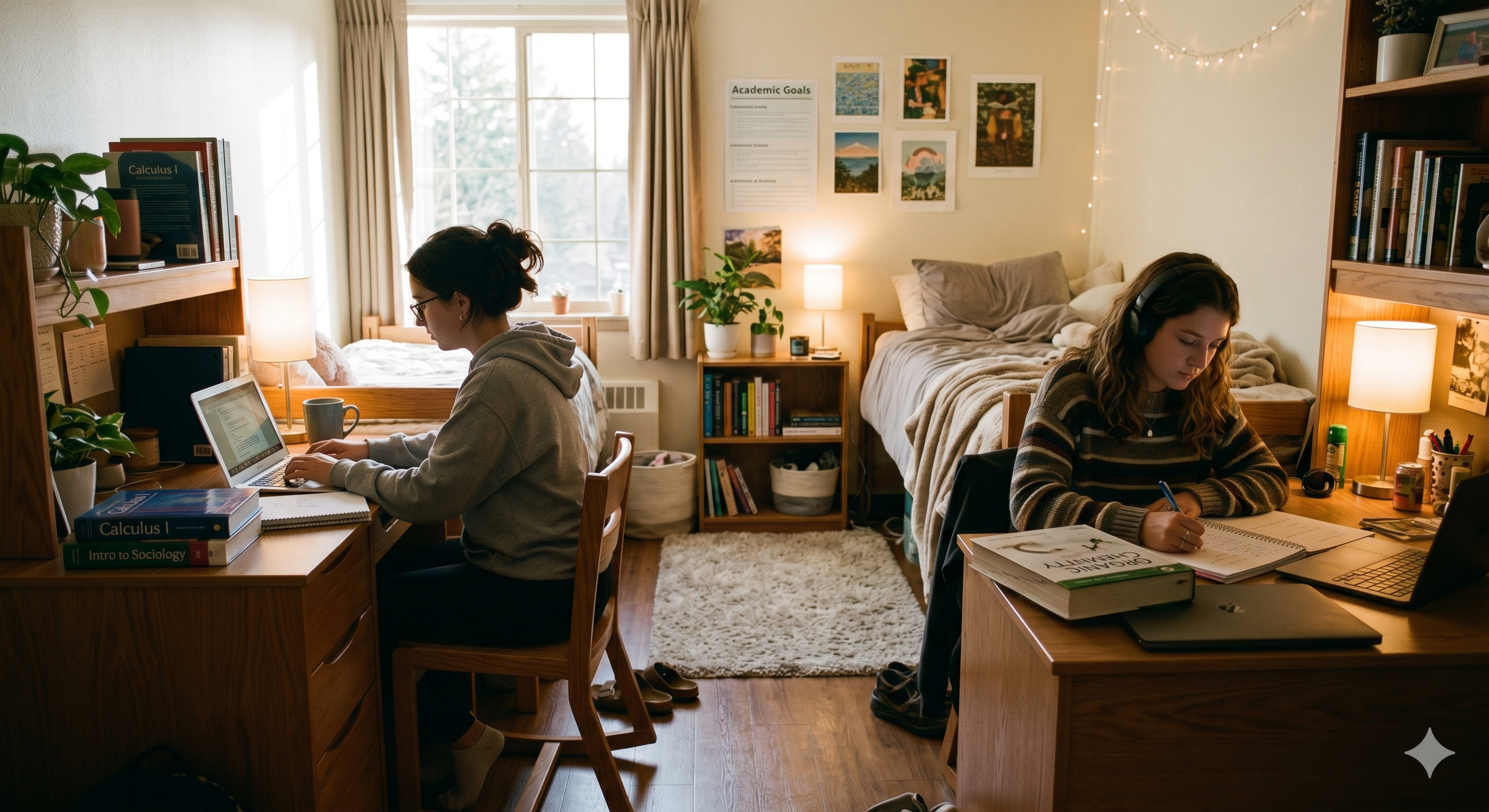
The "independent together" dynamic: best achieved with aligned schedules.
Financial Impact: A Monthly Breakdown
When you share a hostel room or PG with someone from the same college, the cost-sharing logistics become much cleaner. Over an academic year, that's a meaningful difference.
| Expense Type | Solo or Mismatched Roommate | Same-College Roommate |
|---|---|---|
| Monthly Rent (PG double room, Pune) | ₹8,000–10,000 (full burden on you) | ₹4,000–5,000 per person |
| Shared WiFi | ₹600–800 alone | ₹300–400 each |
| Common items (inverter, fan, cleaning) | You bear the full cost | Split evenly |
| Vacation gap expenses | You may pay even when roommate is absent | Aligned breaks, no gap issues |
| Approximate monthly saving | — | ₹3,500–5,500 |
Mental Health and Adjustment
The first semester in a new city can be genuinely difficult. The food is different. The language might be different. The social dynamics are unfamiliar. Having a roommate who is going through the exact same transition — at the exact same college, in the same academic environment — creates a very specific kind of companionship.
"You don't have to explain what you're going through. They're going through it too."
This doesn't mean you need to become best friends. It just means there's someone nearby who understands the specific texture of your stress, and that matters more than people acknowledge.
Compatibility Beyond "Same College": The Factors Students Overlook
Here's where students make the most common mistake: they assume "same college" equals "compatible roommate." It absolutely does not.
The college connection is a good starting point. It's not the whole picture.
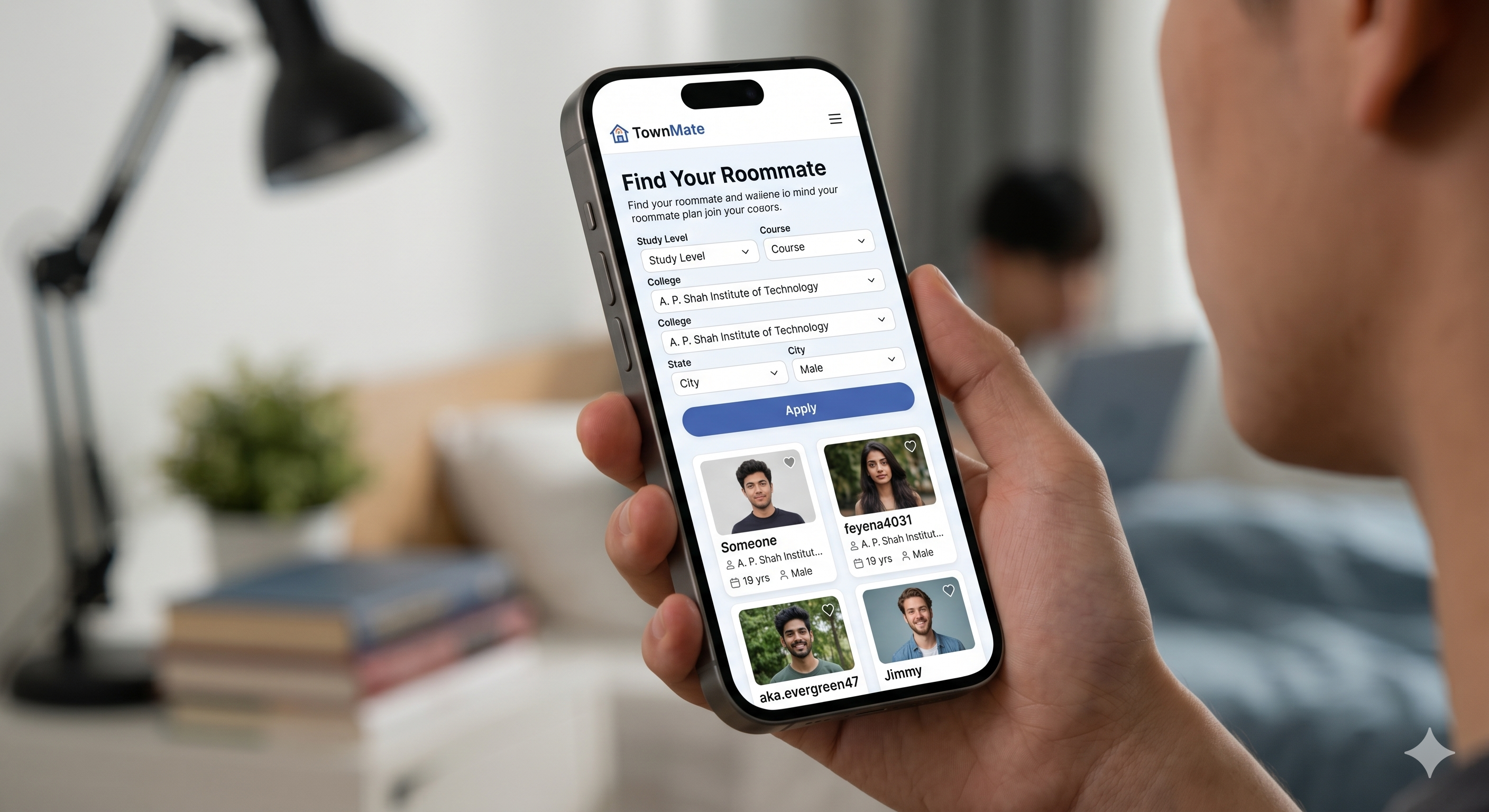
Using a platform like TownMate to filter beyond just the college name.
Compatibility: Beyond the "Same College" Label
Students often make the mistake of assuming "same college" automatically equals "compatible roommate." While the college connection is a fantastic starting point, it is not the whole picture. The students who thrive in their housing situations are those who have a surface-level, honest conversation about key lifestyle factors before committing to a space.
Sleep schedule
Why it matters: Directly affects your rest and study consistency.
Mistake: Assuming classmates share your biological clock.
Study habits
Why it matters: Clash between silence vs. background noise needs.
Mistake: Assuming shared syllabus equals shared study style.
Room cleanliness
Why it matters: The most frequent source of daily friction.
Mistake: Neglecting to discuss standards before move-in.
Guest policy
Why it matters: Your room is your home; rules need to be mutual.
Mistake: Waiting until conflicts arise to set boundaries.
Food habits
Why it matters: Covers cooking, diet, and mess hall timings.
Mistake: Assuming similarity without asking directly.
Social energy
Why it matters: Introvert vs. Extrovert: how much 'me-time' is required?
Mistake: Overlooking this dynamic entirely.
Financials
Why it matters: Handling shared costs, extras, and supplies.
Mistake: Assuming 'vague fairness' will work itself out.
Pro Tip: Whether they are from your college or not, the most successful roommate pairings happen because both students had a conversation about these seven factors before signing any lease.
Student Interviews: What Real Students Said
These insights are drawn from conversations with students across various cities and academic streams, highlighting the practical reality of living with someone from your college.
"I specifically searched for a roommate from my branch on TownMate's college roommate finder. Not just my college, my actual department. At first it felt overly specific, but it paid off. When I needed notes because I was sick, they were right there. When placements hit, we were both preparing together. I don't think I'd have survived third semester without that."
— Arjun, B.Tech 2nd Year, Hyderabad
"Medical college hostels are a specific kind of chaos. The schedule is brutal, the pressure is constant. My roommate was from my batch. There were days we barely spoke because we were both just exhausted. But there was no judgment. No explanation needed. We understood each other's state without saying anything. That silence was actually comforting."
— Shreya, MBBS 1st Year, Nagpur
"My first roommate was from a different college in Delhi. Great guy, honestly. But his college had completely different holidays, different exam patterns. He'd be in study mode exactly when I had free time, and relaxing exactly when I was stressed. We weren't enemies, but the room never felt settled. After one semester I switched to rooming with someone from my own college, and everything just... clicked. Timing matters."
— Karan, BA (Hons) 3rd Year, Delhi
"I was honestly worried about rooming with someone from my college. I thought it would create weird social dynamics, like if we had a fight it would spill into class. That fear is real. But we talked about it beforehand — like, explicitly said 'if we have a problem, we handle it like adults and it doesn't leave the room.' That conversation saved us a lot of drama later."
— Priya, MCA 1st Year, Bengaluru
"My roommate and I were from the same college but different years. He was a senior. That actually worked better than I expected. He knew the system, guided me through the first semester, introduced me to the right study groups. It was less of a peer relationship and more like having a guide in the same space. Highly recommend finding a senior roommate in your first year."
— Rahul, Commerce Student, Mumbai
When Same-College Roommates Go Wrong
It happens. And when it does, it's often harder to navigate than a conflict with a stranger. Here is why things can get complicated, and how to manage the risks:
The Social Spillover Problem
When things get tense at home, running into your roommate in class the next morning is uncomfortable. This is the most common complaint. A misunderstanding about borrowed stuff or noise levels suddenly has a social dimension that wouldn't exist with a stranger.
The fix isn't to avoid same-college roommates. The fix is to establish clear norms early, and to treat the room as a separate space from the college relationship.
The Study Group Overlap
Sometimes two people from the same class and the same room end up competing in ways that become uncomfortable. Same batch, same professor, internal marks that matter. This can create a strange tension where you're technically helping each other but also aware that you're competing.
This is mostly a perception problem rather than a real one, but it's worth being honest with yourself about how comfortable you'd be with that dynamic.
Too Much Togetherness
College. Room. Library. Canteen. If your roommate is also your closest friend in college, you might end up spending every waking hour together. That level of constant proximity can strain even the best friendships.
Healthy distance is genuinely important.
What Seniors Wish They Had Known
Have the awkward conversation early.
Before you move in, talk about cleanliness, noise, guests, and sleep time. Fifteen minutes of mild awkwardness upfront prevents months of passive-aggressive tension.
Don't assume similarity.
Same college doesn't mean same lifestyle. A classmate who seems chill in college might keep the room in a state that drives you insane. Meet in the room before committing.
Build in alone time.
Even if you like your roommate, carve out time when you're not together. Go to the library solo sometimes. Get coffee alone. The friendship survives better with some space.
Use a platform like TownMate to find options, not just WhatsApp groups.
WhatsApp group recommendations are limited to your immediate circle. A proper roommate finder for India like TownMate gives you a wider, more filtered view of who's looking for a room in your college or city — including seniors and students across batches you might not otherwise connect with.
The Hidden Factor: City and College Type
The preference for same-college roommates doesn't play out uniformly across India. The intensity of this preference depends a lot on context.
| Context | Why Same-College Preference Is Stronger | Notes |
|---|---|---|
| Students in new cities (Pune, Hyderabad, Bengaluru) | Social network is almost entirely college-based | Very strong preference |
| Competitive coaching cities (Kota, Patna) | Peer accountability matters enormously | Strong, but sometimes creates pressure |
| Metro cities (Mumbai, Delhi) | Larger social mixing, more options | Moderate preference |
| Small town colleges | Limited options overall | Less choice, proximity matters more |
| Medical and engineering colleges | Schedule-heavy, exam-intensive | Very strong preference due to schedule alignment |
| Arts and commerce colleges | More flexible schedules | Moderate, personal compatibility matters more |
A first-year engineering student who moves from a small town to Pune for college has very few social anchors outside their institution. For them, a same-college roommate isn't just a preference — it's a practical lifeline. Compare that to a student at a Delhi University college who has family in the city and an existing friend network: the same-college preference is there, but it's less urgent.
How to Find a Same-College Roommate Without Depending on Luck
Most students find roommates through batch WhatsApp groups, mutual friend recommendations, or — most risky — random assignment by the hostel. None of these are particularly systematic. Here is a more deliberate, actionable approach to finding your match.
Know Your Actual Requirements
Before posting anything anywhere, decide: What's your budget range? Do you want a hostel or a PG? How important is distance from college? Do you prefer someone from your own batch, or are you open to seniors/juniors?
Post on the Right Platforms
Your college's official WhatsApp group is a start but it's noisy. Use a dedicated roommate finder for India like TownMate, where you can filter by college, city, budget, and preferences. Write a clear, honest listing — 'BCom 2nd year, looking for double occupancy PG near [college name], budget ₹5,000/month, non-smoker, early riser.'
Shortlist and Have a Real Conversation
Don't just exchange one message and decide. Have an actual voice or video call, or meet in person if possible. Ask about sleep schedules. Ask about guests. It's not invasive — it's practical.
Visit the Room Together
If you're looking at a PG or rental apartment, visit together before confirming. Check the distance from college, the internet speed, the mess quality if it's a hostel. Both of you need to be happy with the physical space.
Establish Norms Early
In the first few weeks, set simple ground rules. When guests are welcome. What the cleaning rotation looks like. How shared expenses get split (a shared notes app works fine). These conversations feel slightly formal, but they prevent 90% of future conflicts.
What Most Students Misunderstand
Myth
"We're friends, so we'll be great roommates."
Friendship and roommate compatibility are different. Friendship doesn't tell you anything about cleanliness, sleep schedules, or conflict management.
Myth
"Same college means same schedule."
Even in the same batch, electives, labs, and sports practice create schedule variations that matter in a shared room.
Myth
"It'll be weird to set rules with a friend."
The smoothest relationships involve explicit, slightly awkward upfront conversations. It beats months of unspoken frustration.
Myth
"It's easier to deal with problems if we know each other."
Often the opposite. Conflicts between acquaintances can feel more personal, loaded, and difficult to contain.
A Note for TownMate Users
At TownMate, we regularly hear that the best roommates are often found through structured filtering. The college connection is a great filter, but it's one of many.
Use all available filters: batch year, budget, location, and lifestyle. A student from a different college with a near-identical lifestyle might actually work better for you than a classmate who keeps different hours. The goal isn't just to find someone from your college — the goal is to find someone you can share a space with peacefully.
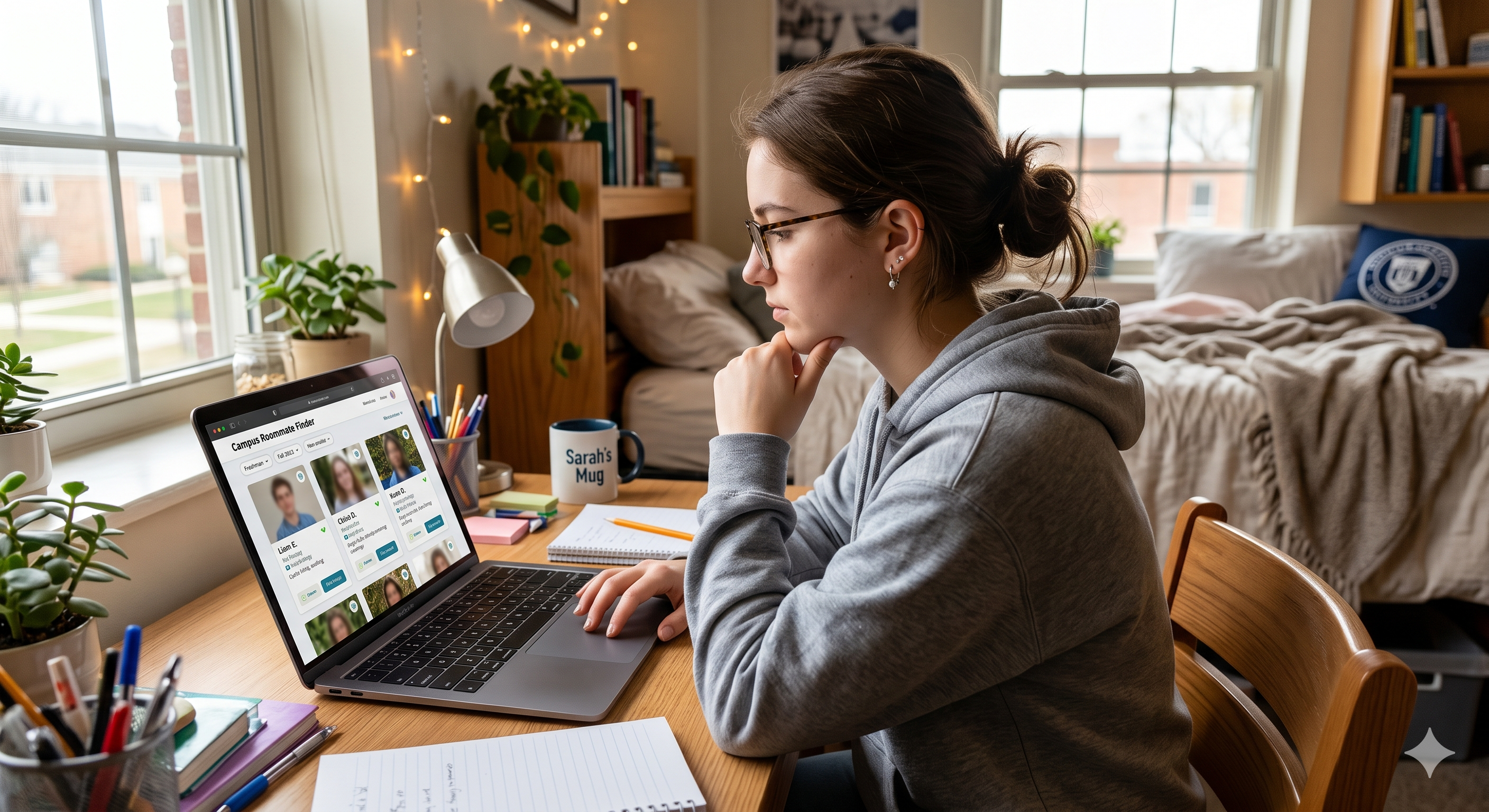
Find your match using data, not just proximity.
Expert Guidance
Expert Tip: Residential Compatibility
Psychologists who study student adjustment consistently find that "residential compatibility" — how well two people coexist in a shared space — is more predictive of academic performance than almost any other environmental factor in the first year of college. Choosing a roommate is not a trivial decision; it directly shapes your sleep quality, your study consistency, and your mental equilibrium throughout the semester.
Senior Student Advice
"Don't sign a 12-month commitment with someone you've only chatted with over WhatsApp. If possible, try for a 3-month arrangement first, especially if you're new to a city and unsure about the location or the person. A lot of students lock themselves into bad situations because they moved too fast."
— Ananya, final year student, IIT Roorkee
Common Mistake Alert
The single most common mistake students make when choosing a same-college roommate is choosing based on existing friendship while skipping the compatibility conversation entirely. The assumption is that liking someone socially means you'll work as roommates. It doesn't. Have the conversation. Every time.
Frequently Asked Questions
Is it better to have a roommate from the same college or the same city?
Same college is usually more practical because of schedule alignment and shared academic context. Being from the same city helps during breaks but matters less day-to-day. Prioritize college over city if you have to choose one.
What should I ask a potential same-college roommate before agreeing to share a room?
Ask about sleep and wake time, how they study (silence vs. noise), how often they expect guests, their cleanliness standard, and how they prefer to split shared costs. These five questions catch most compatibility issues before they become problems.
Can rooming with a classmate damage the friendship?
It can, especially if expectations aren't discussed upfront and if you spend too much time together without any independent space. Many classmate roommate pairs navigate this well by setting clear boundaries and maintaining some separate social time.
How do I find a roommate from my college if I don't know many people yet?
Use a dedicated college roommate finder like TownMate, where you can search by college name and filter by batch year, budget, and location. This is far more effective than waiting for someone to respond in a batch WhatsApp group.
Is it worth using a roommate finder for India instead of just asking friends?
Absolutely. Your friend circle limits you to a small pool of options. A roommate finder India platform opens up your search to people across your college, across batches, and across compatible profiles you wouldn't encounter otherwise — especially useful if you're new to the city.
What if I find someone compatible but they're from a different college?
Don't rule it out. Same college is a useful filter, not an absolute requirement. If the lifestyle, schedule, and budget alignment is strong, a different-college roommate can work very well. Use the compatibility scorecard to evaluate objectively.
How does having a same-college roommate help during exams?
You're both in exam mode at the same time. The room naturally becomes quieter when it needs to be. You can exchange notes, discuss doubts, keep each other accountable, and understand each other's stress without explanation. This practical synchrony is the biggest academic advantage.
Is it smart to room with a senior from my college?
Often, yes — especially in the first year. Seniors know the system, can guide you through administrative chaos, and have already made the adjustment you're currently going through. The dynamic can be mentoring rather than purely peer-based, which many first-year students find genuinely helpful.
What's the best time to start looking for a same-college roommate?
Start at least 4–6 weeks before your semester begins. Rooms in good locations near popular colleges fill up fast. If you're using TownMate or a similar hostel roommate finder, create your profile as soon as you have your admission confirmation.
Should I live in a hostel or a PG with a same-college roommate?
This depends on your budget and preference for structure. Hostels usually have more rules and facilities. PGs offer more flexibility but require more self-management. With a same-college roommate, both can work well — the key is that you're both making the decision together and are aligned on what you want.
How do I handle a conflict with a same-college roommate without it affecting our academic life?
Address issues early and directly, before they build up. Keep the conversation in the room — don't bring hostel grievances into the classroom. If needed, agree upfront that conflicts stay private. Most roommate issues are solvable with a ten-minute honest conversation if caught early.
Are there platforms specifically designed for college hostel roommate finding in India?
Yes. TownMate is one of the platforms designed specifically for Indian students looking for hostel and PG roommates, with college-level filtering. Unlike general housing apps, it's built with student needs in mind, including college-name search, budget filters, and profile-based matching.
Further reading
Deepen your knowledge with these curated TownMate guides, designed to help you navigate your student life with confidence.