
Introvert vs Extrovert: Can Opposites Really Share a Hostel Room?
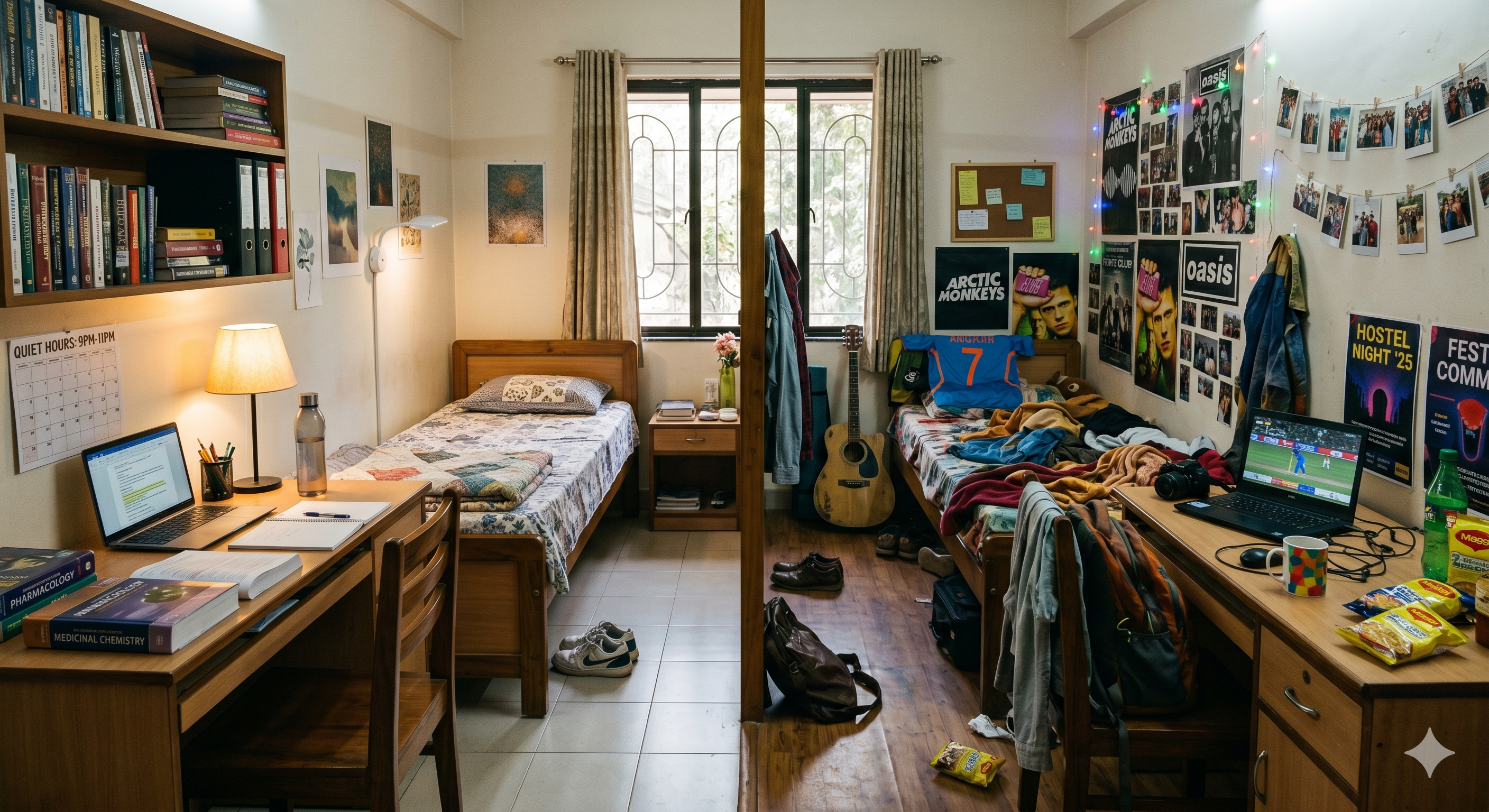
My first hostel roommate was everything I was not.
I remember the night before my first exam. I had planned to sleep by 10:30, wake up at 5, revise quietly, and feel somewhat prepared. By 11 PM, my roommate had three people over, someone was watching cricket highlights with the volume at an aggressive level, and our room smelled like Maggi and overconfidence. I lay there in my bunk with my eyes wide open, silently renegotiating my entire life plan.
He wasn't a bad person. He was actually one of the kindest people I met in that hostel. He just had a completely different definition of what a room was for.
That experience — and the conversations that followed, including the ones that almost ended in disaster and the ones that actually helped — is the reason this article exists. Because nobody tells you that the hardest part of hostel life is not the food, the bathrooms, or the Wi-Fi. It's the person sleeping three feet away from you who runs on a completely different internal frequency.
Quick Summary
What this covers: Personality conflicts in hostel rooms, practical coexistence strategies, real student experiences, and a ground-rules framework.
Key takeaway: Personality opposites can share a room — but only if both people are intentional about it from day one.
Why Personality Type Matters More Than You Think
Most roommate-matching conversations stay surface-level: sleep schedule, cleanliness, smoking, noise. Those are important. But they are downstream of something more fundamental — how a person recharges.
The Extrovert Reality
An extrovert comes back from a long day of lectures and feels drained. The solution? Call someone over, talk to people in the corridor, keep the room lively. That activity is what restores them.
The Introvert Reality
An introvert comes back from the same day and feels equally drained. The solution? Quiet. Alone time. Maybe music through headphones. Maybe nothing at all. The room being empty and still is what restores them.
When those two people share 120 square feet, the room cannot do both things at once. That's the core of introvert-extrovert roommate tension. It's not about who's right. It's about the fact that the same physical space needs to serve two fundamentally opposite recovery needs — at the same time.
The TownMate Insight: At TownMate, this is one of the most common complaints we hear from students searching for accommodation. They describe it with phrases like "my roommate never lets me breathe" or "my roommate makes me feel like I'm being antisocial just by existing." Neither person is being unreasonable. They just haven't built a shared system yet.
The Real Friction Points (That Nobody Talks About Beforehand)
Before you can fix anything, you need to name what's actually going wrong. Here are the specific situations where introvert-extrovert differences cause the most damage in a shared hostel room:
The Guest Problem
Extroverts often see the room as a social space. Introverts often see it as a private retreat. Neither view is wrong, but when unaddressed, you end up in a room where one person always feels like a guest in their own space.
The Noise Baseline
This is subtler than just 'loud vs quiet.' Extroverts often have background noise running not because they're being inconsiderate, but because they find silence uncomfortable. Introverts notice every sound; the same background hum that barely registers for one can actively prevent the other from thinking clearly.
The Social Obligation Trap
When your extrovert roommate introduces you to their friends, there's an unspoken expectation to engage. For an introvert, constant small talk with near-strangers is genuinely exhausting. Over time, the introvert starts feeling like they have to perform friendliness just to exist in their own room.
The Sleep Schedule Drift
Extroverts tend to sleep later because social energy lasts longer into the night. Introverts tend to deplete earlier. A 1 AM bedtime for one person and a 10:30 PM bedtime for the other creates a structural conflict that plays out every single night.
The Judgment Spiral
"This is the one that causes lasting damage. The extrovert starts feeling like their roommate is 'too uptight' or 'boring.' The introvert starts feeling like their roommate doesn't respect them. Once resentment builds a narrative, small incidents feel like proof of a larger problem."
Can It Actually Work? What the Evidence (and the Students) Say
Honestly — yes. But with conditions. The research on roommate compatibility consistently shows that personality type alone is not a reliable predictor of whether two people will get along. What predicts success is communication frequency and the presence of explicit shared agreements.
A study from the Journal of College Student Development found that students who had a formal roommate conversation in the first two weeks of living together reported significantly fewer conflicts at the 3-month mark — regardless of personality type. The more practical finding: introvert-extrovert pairings that failed weren't failing because of personality. They were failing because neither person had ever actually said what they needed.
What Students Actually Experience: Voices From the Hostel
"My roommate was the most popular person in our batch... I needed silence to memorize pharmacology tables, and she needed people around to feel okay. For the first two months we basically communicated through passive-aggressive rearranging of things on the study table. Then one night I just told her — I need the room quiet from 9 to 11 PM. That's it, just two hours. She immediately said 'why didn't you just say that earlier?'"
"I'm the extrovert in this situation... My roommate barely spoke to me for the first month and I genuinely thought he disliked me... Nobody tells extroverts that the introvert declining your invite is not a rejection. Once I understood that, I stopped taking it personally and things got much easier."
"Hostels in Mukherjee Nagar are a specific kind of chaos. My roommate dealt with stress by talking about it endlessly. I dealt with stress by going completely inward and silent. What helped us was a shared Google Calendar where we marked our 'do not disturb' hours and our 'I'm open to chat' hours. It sounds clinical but it genuinely worked."
"Kota coaching hostel life is its own category. My roommate was a social butterfly in a place where everyone is burning out. We ended up splitting the room informally — his side near the door for when his friends would stop by, my side near the window. Looking back, we actually balanced each other out."
"The hardest part for me wasn't the noise or the guests. It was the guilt... I spent months performing extroversion that I didn't have. A counselor at our college eventually helped me understand that needing alone time is not a character flaw. I wish I'd known that from the beginning."
The Compatibility Matrix: How Different Combinations Play Out
| Scenario | Common Issues | Outcome | What Helps |
|---|---|---|---|
| Strong Introvert + Strong Extrovert | Noise, guests, energy mismatch | Tense if unaddressed, fine with clear rules | Explicit quiet hours & guest policy |
| Introvert + Ambivert | Moderate noise, social pressure | Usually manageable | Casual check-ins |
| Extrovert + Ambivert | Minor disagreements on hosting | Generally smooth | Flexible scheduling |
| Two Introverts | Lack of communication | Can drift into isolation | Intentional check-in moments |
| Two Extroverts | Collective chaos, never quiet | High energy but aligned | Mutual study time agreement |
| Introvert + Extrovert (Good Comm.) | Occasional friction | Genuinely complementary | Early honest conversation |
The Ground Rules Conversation: A Practical Framework
Most students skip this conversation because it feels awkward. Having it in week one feels like you're preparing for conflict when there isn't any yet. But that's exactly the right time — before the habits form.
Week 1: The Non-Negotiables
Sit down for 15 minutes and cover just four things: Sleep/Quiet hours, Guest policy, Desk/Study time, and Emergency signals. This prevents approximately 80% of the conflict that will otherwise happen over the next six months.
Month 1: The Check-in
After about four weeks, have one more conversation. Ask each other what's working and what isn't. Use specific examples: "When your friends stayed past midnight on a Wednesday, that was hard for me." Specific is easier to fix than vague.
The Ground Rules Conversation
Most students skip this because it feels awkward. But having it in week one—before habits form—prevents approximately 80% of future conflict.
Sleep & Quiet Hours: What time do you need the room to be reasonably quiet? Not silent, just not active-social.
Guest Policy: How often, for how long, at what times? Is there any advance notice expected?
Desk/Study Time: If one person needs concentration, what does the other do?
Emergency Signals: How do you indicate you need space? ('If my headphones are on, I'm in focus mode' is a legitimate system.)
Specific is easier to fix than vague.
After about four weeks, have one more conversation. Ask each other what's working and what isn't. This is easier than it sounds because by now you have actual examples.
"Hey, when your friends stayed past midnight on a Wednesday, that was hard for me."
Concrete Statement (Recommended)"I feel like you don't respect my space."
Spiral Statement (Avoid)Honest Adjustments for Every Personality
For the Introvert
This is not about changing who you are. It's about small adjustments that prevent unnecessary conflict.
- 01.
Communicate early
Say it on day three, casually: 'Hey, I'm pretty private about the room in general — just so you know what to expect from me.'
- 02.
Stop expecting mind-reading
Most extroverts are not testing your limits. If you've never said anything, they have no reason to suspect something is wrong.
- 03.
Create a signal system
Headphones or a specific study lamp that means 'I'm in work mode' communicates your state without needing a conversation.
- 04.
Claim your territory
A shelf, a corner, or a chair. A small space that is definitively yours restores a psychological sense of privacy.
For the Extrovert
These small habit shifts ensure your natural energy doesn't accidentally drain your roommate's peace.
- 01.
Quiet is not rejection
Your roommate declining to hang out is not about you. That framing is the fastest way to create unnecessary tension.
- 02.
The 20-Minute Notice
Text before bringing people over. It's not about permission; it's about preparation. Introverts handle things better when not surprised.
- 03.
Read the room literally
If the lamp is on, headphones are in, and the textbook is open, that is not a moment to discuss weekend plans.
- 04.
Acknowledge the cost
Social recovery in a shared room uses a shared resource. It's not wrong to be social, but it requires mindful negotiation.
Living With Your Opposite: The Trade-offs
| Perspective | The Pros | The Cons |
|---|---|---|
| For the Introvert | Pushed gently out of isolation; social network built by default; extrovert handles social admin. | Constant energy drain; loss of alone time; noise and guests. |
| For the Extrovert | Grounding influence; quieter rest; someone who listens more than talks. | Feels rejected when roommate withdraws; can feel guilty for natural habits. |
| For the Room | Complementary rhythms: one brings energy, one brings calm. | Without rules, these rhythms clash constantly. |
| For Studies | Mutual accountability; extrovert prevents over-isolation; introvert prevents over-distraction. | Misaligned focus times cause major disruption. |
Common Myths That Make This Harder
Myth
We'll just figure it out naturally.
Reality
Natural equilibrium defaults to whoever is more assertive. In an introvert-extrovert pair, this is usually the extrovert — not out of malice, but because they are actively creating the environment.
Myth
Asking for quiet is being antisocial.
Reality
Asking for quiet time is being a functioning adult. You are not responsible for your roommate's entertainment.
Myth
Extroverts are always the problem.
Reality
Introverts can be equally difficult—going completely dark, refusing to communicate, or making the roommate feel like they're walking on eggshells.
Myth
You either click or you don't.
Reality
Chemistry is optional; systems are not. Clear, mutually agreed operating rules allow even roommates who don't 'click' to coexist peacefully.
A Practical Action Plan: Days 1 Through Month 2
The First Hello
Introduce yourself. Names, hometown, course. Plant the seed that you're someone who communicates.
Ground Rules
Have the 4-point conversation. Keep it friendly: 'Just wanted to be clear from the start so it doesn't get weird later.'
Observation Phase
Notice patterns without judgment. Wake-up times, study habits, social needs. You're collecting data, not scoring points.
The Proactive Gesture
Make one small accommodation unasked. If they need silence before 8 AM, be quiet. This gesture builds more trust than any conversation.
Address Issues Early
If something bothers you, state it as information, not accusation: 'I struggle to sleep with the light on past midnight, can we figure something out?'
The 10-Minute Check-in
Ask what's working. Share one adjustment. It’s easier to tweak a rhythm than to fix a conflict that's already boiled over.
Establish Rhythm
If a persistent issue remains, involve a warden or respected senior as a neutral mediator—not as a last resort, but as a path to objective resolution.
Frequently Asked Questions
Is it realistic to expect an extrovert to stay quiet during exam season?
Yes — but only if you've asked. Most extroverts are genuinely willing to adjust during high-stakes weeks. The mistake is assuming they'll automatically know without being told. 'I have my first major exam on Thursday — can we keep things quieter in the room from Tuesday night?' is a completely reasonable request and most people will honor it.
How do I tell my roommate I need alone time without being rude?
Frame it around your own need rather than their behavior. 'I need some quiet time to recharge this evening' is different from 'can you be less noisy.' One is information about yourself. The other is a complaint about them. The first gets a much better response.
What if my extrovert roommate's friends are always in our room?
This is a guest policy conversation. Have it directly with your roommate, not passive-aggressively. A reasonable baseline: advance notice before guests arrive, a shared understanding of cut-off time for late visits, and an acknowledgment that the room belongs to both of you. Many students at TownMate-listed hostels find that a simple 24-hour notice expectation resolves this almost entirely.
My introvert roommate never talks to me. Should I be worried?
Not necessarily. Some introverts are deeply private and need significantly less social interaction than extroverts to feel okay. Check in directly once — 'hey, are we good?' — and take the answer at face value. If they say they're fine, believe them. If there's actually something wrong, they'll appreciate that you asked.
Can an introvert become more comfortable in a social hostel environment over time?
Yes. Most introverts who've lived in hostel environments describe a period of adjustment — usually 4 to 8 weeks — where the constant social stimulation becomes slightly less overwhelming. The baseline doesn't shift, but the tolerance goes up. The worst approach is forcing social participation. The best approach is creating a private space where they can fully recover.
What if setting rules feels too formal and awkward?
It doesn't have to be a sit-down meeting. Some of the most effective 'roommate agreements' happen over chai at the end of a first week — casual, conversational, but covering the real things. The medium doesn't matter. The conversation does.
I'm an extrovert who moved in with an introvert and I feel like I can't be myself. What do I do?
This is valid and worth addressing directly. Being yourself doesn't have to mean recreating a social environment inside the room every day. The corridor, common room, mess, and campus are all spaces where you can be fully extroverted without it coming at someone else's expense. Talk to your roommate about what you need and ask what they need. There's almost always a middle ground.
Should I request a room change if our personalities are too different?
A room change is a legitimate option, but give the conversation a real chance first — not a vague two-day trial, but an actual ground-rules discussion followed by a month of genuine effort. Most students who've done this report that things improved significantly. Those who switched rooms without trying often found the same issues waiting with a new person.
How do I handle the situation if my roommate tells friends I'm antisocial?
First, address it directly with your roommate — tell them that you've heard what's being said and it's not accurate. Explain the difference between being antisocial and being introverted. Then decide how much it matters to you. Social reputation in a hostel is real, but it's also more malleable than it feels in the moment. One genuine connection in your batch is worth more than surface-level approval from a group.
What's the fastest way to reset a roommate relationship that's already gone sideways?
Acknowledge the tension directly. Not with blame — with honesty. 'I think we got off to a weird start and I don't want this to be awkward for the rest of the year. Can we start over?' This works more often than students expect because both people are usually tired of the tension by the time one of them breaks it.
Do shared hostel rooms in India have any formal rules about guests?
Most hostels have written guest policies in their rulebooks that students rarely read. Check yours — especially for co-ed hostels, guest hours are often regulated by the institution. Knowing the official rules gives you a neutral reference point that isn't about your preference. It's 'the hostel doesn't allow guests past 10 PM,' not 'I don't want your friends here.'
What time should quiet hours realistically start in a shared hostel room?
Based on conversations with students across different types of hostels, a 10:30 PM start for quiet hours works for most combinations. Academic-season adjustments (especially before exams) often need this moved earlier. The key is agreement, not a specific time.
Further reading
Related TownMate articles you may find useful: