
Why most hostel students waste hours every day (and how to avoid it)
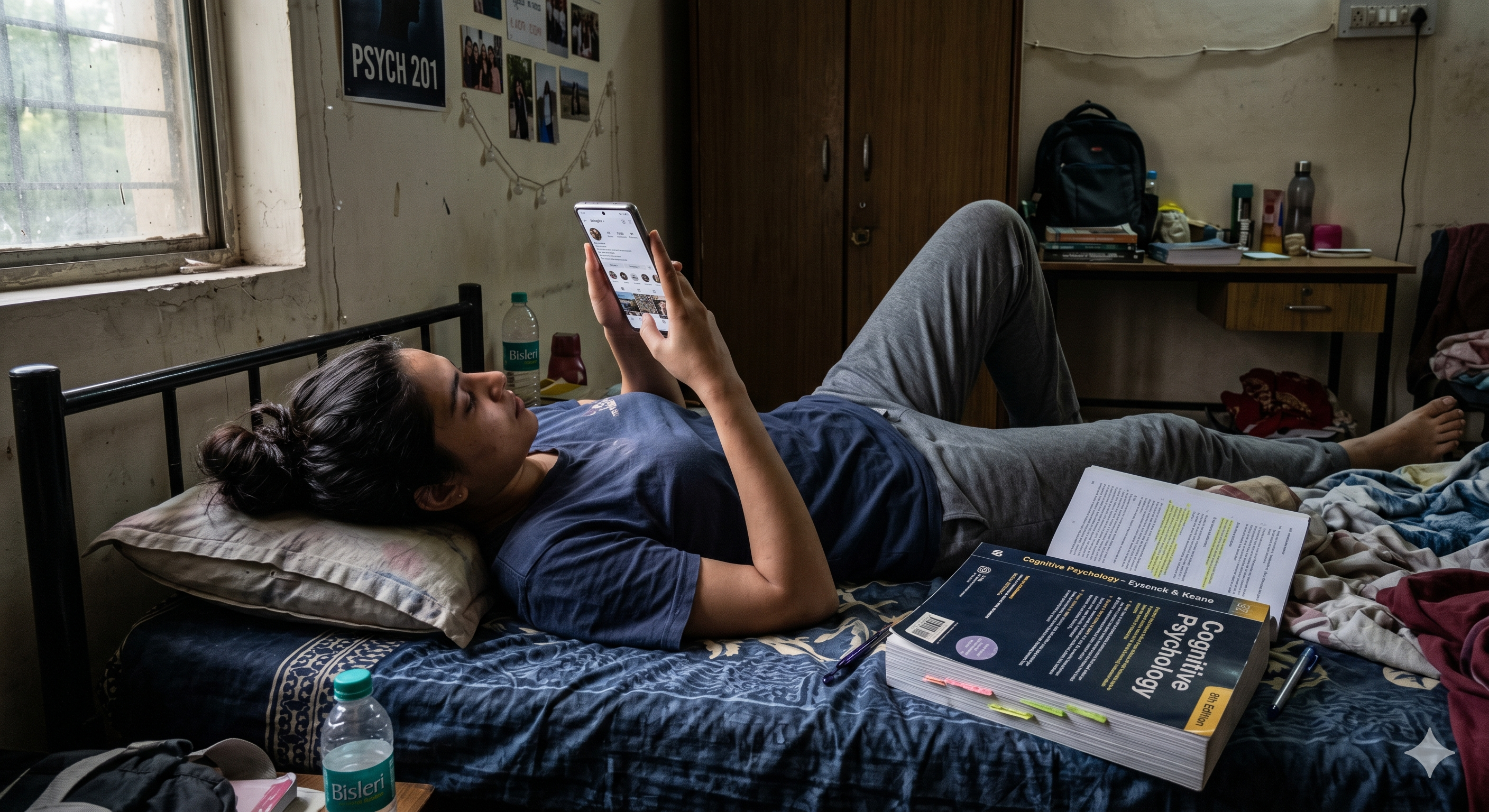
My second semester started with a promise I made to myself: wake up at 6 AM, study for two hours before class, use the library after lunch, and sleep by 11 PM. By the third week, my actual routine looked like this: alarm at 6, snooze until 7:15, rush to class, come back to the room at 2 PM and lie down "for ten minutes" that always became ninety, scroll through Instagram until evening chai, attend one half-hearted study session, then sit with friends in the corridor talking about nothing specific until midnight.
I was not being lazy. I was genuinely trying. But hostel life has a way of dissolving your best intentions. The environment works against you in ways nobody explains before you move in. Your room is simultaneously your bedroom, your study, your entertainment zone, and your social lounge. There is no physical separation between relaxation and work. And because everyone around you is drifting through the same foggy routine, it starts to feel normal.
This is the core reason why most hostel students waste hours every day. Not because they do not care about their studies or careers. Because the structure of hostel life, if left unmanaged, is designed to consume time quietly.
At TownMate, we have spoken to hundreds of students about their daily routines while helping them find better accommodation and study setups. The patterns are strikingly consistent. Students across cities, courses, and backgrounds describe losing the same three to five hours to the same set of invisible traps.
This article is a diagnostic tool. It will help you identify exactly where your time disappears, why standard advice fails in a hostel setting, and what specific changes produce results without requiring superhuman discipline.
At a Glance
What this covers: A forensic breakdown of the 6 biggest time leaks in hostel life, why willpower-based advice fails, a tested environment-first system for recovering lost hours, and real routines from students who fixed this problem.
Key takeaway: The problem is rarely motivation. It is almost always environment and triggers. Change the environment, and the hours reappear without needing discipline.
A quick self-check: how many hours are you actually losing?
Before reading further, run through this honestly. No judgment. This is just a mirror.
| Time Trap | Happens to You? | Est. Daily Loss |
|---|---|---|
| Snoozing the alarm more than twice | Yes / No | 20-45 min |
| Scrolling phone in bed before getting up | Yes / No | 15-40 min |
| "Quick nap" after lunch | Yes / No | 30-90 min |
| Sitting in a friend's room with no purpose | Yes / No | 30-60 min |
| Watching reels/shorts during study breaks | Yes / No | 40-90 min |
| Staying up past midnight talking in the corridor | Yes / No | 45-90 min |
| Waiting for friends to eat, study, or leave | Yes / No | 20-40 min |
| Reorganizing desk/bag to avoid starting work | Yes / No | 15-30 min |
If you checked "Yes" on four or more of these, you are likely losing between three and five hours every single day. That is 90 to 150 hours per month. Enough time to complete an entire online certification, read twelve books, or prepare thoroughly for two full exam subjects.
The 6 invisible time leaks of hostel life
1. The post-lunch collapse
This is the single largest block of wasted time for hostel students across the country. You come back from your last morning class or from lunch at the mess. You are slightly drowsy from a carb-heavy meal. You tell yourself you will lie down for fifteen minutes. You wake up at 4 PM with a dry mouth and a vague sense of guilt.
The post-lunch collapse is not about being lazy. It is physiological. Heavy mess food (rice, dal, roti with oily sabzi) triggers a blood sugar spike followed by a crash. Your body genuinely wants to sleep. The problem is that your hostel bed is three feet away from your study desk, and there is nobody enforcing a boundary between the two.
"My room became a trap after lunch. I started going directly to the library after eating, without even entering my room. That one change saved me two hours every afternoon." — 3rd Year Student, VIT Vellore
2. The infinite scroll spiral
You pick up your phone to check one notification. Twenty-five minutes later, you are watching a stranger review street food in Jaipur. This is not a failure of willpower. Social media apps are engineered by teams of behavioral psychologists to keep you scrolling. You are not weak for falling into this trap. You are human.
The hostel environment makes this worse because there is no external accountability. Nobody is watching. Your roommate is probably doing the same thing on their own phone. There is a strange shared comfort in collective procrastination.
| Scroll Session | Duration | Daily | Monthly |
|---|---|---|---|
| Morning (in bed) | 20 min | 20 min | 10 hrs |
| Between classes | 15 min x 2 | 30 min | 15 hrs |
| Study breaks | 25 min x 2 | 50 min | 25 hrs |
| Before sleep | 30 min | 30 min | 15 hrs |
| Total | 2 hrs 10 min | 65 hrs/month |
Sixty-five hours a month. That is more time than most students spend in actual focused study across the same period.
3. The corridor trap
Hostel corridors are social magnets. You step out of your room to fill your water bottle and bump into someone. A five-minute chat turns into forty minutes of standing around, discussing nothing particularly important. You go back to your room, sit at your desk, and realize an hour has passed.
The corridor trap is especially powerful in the evening hours between 6 PM and 9 PM, which are also the most productive potential study hours for most students.
4. The group dependency problem
Hostel students develop a habit of doing everything in groups. Going to the mess, going to class, going to the library, going to the canteen. This creates a dependency that silently eats time every day. You are ready to leave for the library at 3 PM. Your friend says "five minutes." Those five minutes become twenty. Now you reach the library at 3:25 instead of 3:00.
"I realized I was scheduling my entire day around other people's readiness. The day I started going to the library alone, I gained an extra hour of study time." — Student, BITS Pilani
5. The "I'll start after..." procrastination loop
"I'll start studying after this episode ends." "I'll start after dinner." "I'll start after I organize my notes." Every hostel student recognizes this loop. The trigger is almost always the gap between intention and action. You know you should study, but starting feels like climbing a wall.
6. The late-night illusion
Many hostel students believe they are "night owls." For a small percentage, this is true. For the majority, staying up late is just socially acceptable procrastination.
Why "Standard" Advice Fails (And What Works Instead)
Productivity advice online is written for people with private offices. You aren't one of them. You live in a shared, chaotic, unpredictable box. Stop trying to "fix" your willpower and start engineering your environment.
Standard
Wake up at 5 AM
Roommate is up until 2 AM; your alarm causes a war.
Find one 'quiet hour' block that fits your natural energy, not the guru's clock.
Standard
Create a dedicated study space
Your desk is 2 feet from your bed. Proximity = Sleep.
Make your room the 'sleep zone' only. Do all deep work in the library or common hall.
Standard
Eliminate all distractions
You live in a corridor with 200 people. Silence is not an option.
Invest in noise-cancelling earbuds and create a physical 'do not disturb' visual.
Standard
Follow a strict daily routine
Mess hours and class changes make fixed schedules rigid.
Stop planning hours. Plan flexible 90-minute deep-work 'sprints'.
Standard
Use the Pomodoro technique
A 5-minute break becomes 40 minutes of scrolling.
Take 'movement breaks'—walk, fill your bottle, stretch—no screens allowed.
Standard
Tell people not to disturb you
It’s a hostel. People will knock. That’s the culture.
Leave the building. Proximity is the only true barrier.
Student Interviews: Real Routines That Recovered Lost Hours
Nikhil
Computer Science, COEP Pune
"My biggest realization was that my room was the problem, not me. I tried everything: app blockers, sticky note reminders, motivational wallpapers. Nothing worked because the bed was always right there. I started treating my room as a place only for sleeping and relaxing. All my studying moved to the department reading room. Within two weeks my daily productive hours went from about two to almost five. Same person, different location."
Shreya
CA Aspirant, Coaching in Delhi
"I was losing almost an hour every day waiting for my friend group to get ready for meals and study sessions. One day I just went to the library alone at 2 PM instead of waiting until 3 PM for everyone else. I got a full extra chapter done. Now I go alone most days and we meet up in the evening. Nobody was offended. They were just surprised I had the discipline to go by myself."
Ravi
Mechanical Engineering, NIT Warangal
"The late-night myth nearly cost me a semester. I was convinced I studied best after midnight. My CGPA dropped from 8.1 to 6.7 in the third semester. A senior told me to track my actual page count during night sessions versus morning sessions. I was covering twelve pages in the morning in one hour and barely four pages at night in two hours. That data forced me to change. I now sleep by 11:30 PM and wake at 6:15 AM. My grades recovered completely."
Fatima
MBBS, Mysore
"Medical students have massive syllabi, so every wasted hour hurts more. My time leak was the post-lunch nap. I solved it by calling my mother at 2 PM every day for ten minutes while walking around the campus. The sunlight, the walk, and the conversation kept me awake. By 2:15 I was alert enough to go to the reading hall. It sounds like a small thing but it gave me back ten extra hours every week."
Aditya
MBA Prep, Kota
"In Kota, everyone wastes time in the same way: sitting in someone else's room discussing how stressed they are about the exam. We would spend forty minutes complaining about the syllabus instead of covering it. I started a rule for myself: no room visits before 7 PM on weekdays. If someone came to my room, I would say 'let us talk at chai time.' It felt awkward for two days and then it became normal."
The environment-first recovery system
This is not a generic "plan your day" checklist. It is a sequence of environmental changes that remove the need for constant discipline.
- Carry a small notebook or phone note
- Log every activity switch
- Record duration until sleep
- Observe—don't change yet
- Review your 48-hour log
- Circle the 3 largest unproductive blocks
- Target typical leaks: nap, scrolling, or socializing
- Focus on these 3-4 wasted hours
- Pick your biggest time leak
- Change your physical location for that slot
- Go mess-to-library directly
- Don't rely on motivation—rely on geography
- Choose one 90-minute study block
- Make it non-negotiable
- Keep same time, same location
- Build your day around this anchor
- Wait for the first block to feel automatic
- Add a second 90-minute sprint
- Total 3 hours of deep work
- Beat the hostel average
- Assess what stuck and what failed
- Double down on your wins
- Drop what didn't work
- Recover 2-3 hours of hidden time
Key Takeaway: The goal is not perfection. The goal is recovering two to three hours per day that were previously invisible. The hours are not lost; they are just misallocated.
Original insights: what nobody tells you about hostel productivity
The myth of the "productive roommate"
Students often assume that having a studious roommate will make them more disciplined. Research on behavioral mirroring suggests the opposite is equally likely: if your roommate procrastinates, you will unconsciously mirror that behavior. Your roommate's habits are contagious, for better or worse.
Choose your study environment based on the collective behavior of the people in that space, not just one individual.
The Sunday reset illusion
Many students "plan" their week every Sunday night. They create beautiful color-coded timetables. By Tuesday afternoon, the plan is abandoned. The problem is that planning gives you a dopamine hit that feels like progress. You feel organized and motivated after making the plan, which satisfies the psychological need to "do something" about your productivity, without actually changing any behavior.
Plans without environmental changes are just decorated procrastination.
What third-year students universally regret
When we asked final-year students across five campuses what they wished they had understood earlier, the most common answer was not "I should have studied harder." It was "I should have left my room more." The room is comfortable, familiar, and full of distractions.
Every senior student who improved their grades describes the same turning point: they stopped trying to make their room a productive space and accepted that it never would be.
Authority Insights
Senior Student Advice
"The single best thing I did in my third year was buy a pair of noise-cancelling earbuds for 1,200 rupees. Not for music. Just for silence. I would put them in, sit in the library, and suddenly the hostel chaos did not exist."
— Karthik, NIT Surathkal
Common Mistake Alert
Do not download productivity apps to fix a productivity problem. Most students spend more time setting up the app than they ever spend using it. A plain notebook with three tasks written on it is more effective. Simplicity wins.
Expert Tip
"Students consistently overestimate how much time they have and underestimate how much time they waste. The gap between perception and reality is usually two to three hours per day. Track your actual time use for 48 hours."
— Prof. Meenakshi Iyer, Symbiosis
Frequently Asked Questions
Why do hostel students waste so much time compared to day scholars?
Day scholars have built-in structure: commute times, family meal schedules, and parental presence that create natural boundaries. Hostel students have total freedom with zero external structure, which paradoxically makes it harder to stay productive without deliberate systems.
How many hours should a hostel student study per day?
The number matters less than the quality. Three hours of focused, distraction-free study consistently outperforms six hours of scattered, phone-interrupted sessions. Aim for two to three focused 90-minute blocks rather than a raw hour count.
What is the best time to study in a hostel?
Early morning (6 AM to 8 AM) and mid-afternoon (2 PM to 4 PM in the library) are consistently reported as the quietest and most productive windows. Evening hours (7 PM to 10 PM) are the noisiest in most hostels.
How do I stop scrolling my phone in the hostel?
Move social media apps off your home screen. Set a single 30-minute "scroll window" in the evening. During study blocks, leave your phone in a drawer or give it to your roommate. Physical separation works far better than app timers.
Is it okay to take a nap after lunch in the hostel?
A 20-minute power nap can genuinely help if you set a hard alarm and get up. The problem starts when the nap stretches to 90 minutes. If you cannot reliably wake up after 20 minutes, skip the nap entirely and go to the library instead.
How do I tell my friends I need to study without being rude?
"I need to finish this chapter, let's catch up at dinner" is a complete, respectful sentence. Real friends will understand. If someone consistently pressures you to waste time, that is not friendship, it is peer pressure dressed up as socializing.
Does the hostel environment affect academic performance?
Absolutely. Multiple studies on student performance show that living environment is a stronger predictor of grades than intelligence or prior academic record. Noise levels, sleep quality, and social dynamics in hostels directly impact concentration and retention.
How can I be productive if my roommate is always distracting?
Stop trying to study in your room. The library, an empty classroom, or even a quiet corner of the campus is a better option. You cannot control your roommate. You can control where you choose to work.
What should I do if I have already wasted most of the semester?
Start the Day 1 audit from the action plan in this article today. You cannot recover lost time, but you can prevent further loss. Even four weeks of focused work before exams can significantly improve your results compared to continuing the drift.
Are hostel students who wake up early more successful?
Not necessarily. The key factor is consistency, not the specific hour. A student who reliably studies from 10 PM to midnight every night will outperform someone who sets a 5 AM alarm, hits snooze, and feels guilty about it all morning.
How do I build a study routine that actually sticks in a hostel?
Start with one anchor block: same time, same location, every day. Do not try to overhaul your entire schedule at once. Once one block becomes automatic (usually after 10-14 days), add a second. Build slowly. Ambitious schedules collapse. Modest, consistent ones survive.
Can TownMate help me find a hostel with a better study environment?
Yes. TownMate listings include information about study rooms, library access, noise levels, and common area availability. If your current hostel environment is genuinely unworkable, exploring options with better infrastructure can be a practical long-term solution.
Further reading
Related TownMate articles you may find useful: